
The Scientific Realities Behind 3 Major Hyaluronic Acid Filler Myths
June 1, 2026
 If you spend even ten minutes scrolling through social media today, you will likely see alarming videos about dermal fillers. From claims that they never dissolve to warnings about "filler migration" and the dreaded, over-filled "pillow face," online algorithms are fueling a wave of anxiety.
As a dermatologist, I see the real-world impact of this misinformation every day in my clinic. Patients come in wanting to refresh their appearance, yet they are terrified that temporary treatments will permanently alter their features.
The truth? Hyaluronic Acid (HA) fillers remain one of our most powerful assets for graceful aging and facial beautification. The issues filling your social media feeds are not inherent flaws of the product itself; they are almost always the result of incorrect technique, poor product choice, or a fundamental misunderstanding of facial anatomy.
Let’s separate online fiction from clinical science by breaking down the three biggest HA filler myths.
Myth 1: HA Fillers Last for a Decade and Constantly "Migrate"
The Claim: Social media accounts often point to MRI scans to claim that HA fillers linger in the face for ten years or more, shifting away from the injection site to cause long-term facial distortion.
The Reality: Hyaluronic acid is a naturally occurring sugar molecule in our skin that holds water. In its natural state, your body breaks it down in a matter of days. To make it last long enough for a cosmetic treatment, manufacturers "cross-link" the HA molecules together.
While it is true that modern high-resolution imaging shows microscopic traces of HA can remain in the tissue longer than the standard 6 to 18-month breakdown window, this is vastly different from a large volume of active filler actively moving across your face.
True filler migration—where product moves from its original placement—is largely preventable. It happens primarily due to two clinical errors:
- Over-volumization: Pushing too much product into an area that cannot support it (such as over-injecting the lips), forcing the gel to spread into neighboring tissues.
- Incorrect anatomical placement: Injecting filler into the wrong tissue layer, where constant muscle movement pushes the product out of place.
When a highly cohesive filler is placed correctly within its intended anatomical boundaries, it stays where it belongs, integrating naturally into the tissue until your body gradually metabolizes it.
Myth 2: Fillers Inevitably Lead to an Unnatural "Pillow Face"
The Claim: If you get fillers, you will eventually end up looking puffy, distorted, and distinctly unnatural.
The Reality: The over-inflated look known as "pillow face" is not an issue with the product; it is an issue of clinical philosophy. It occurs when an injector relies solely on filling lines rather than understanding the underlying structural cause of facial aging.
Facial aging isn't just skin-deep. It is a multi-layered process involving the resorption of bone, the laxity of retaining ligaments, and the deflation or shifting of deep and superficial fat pads.
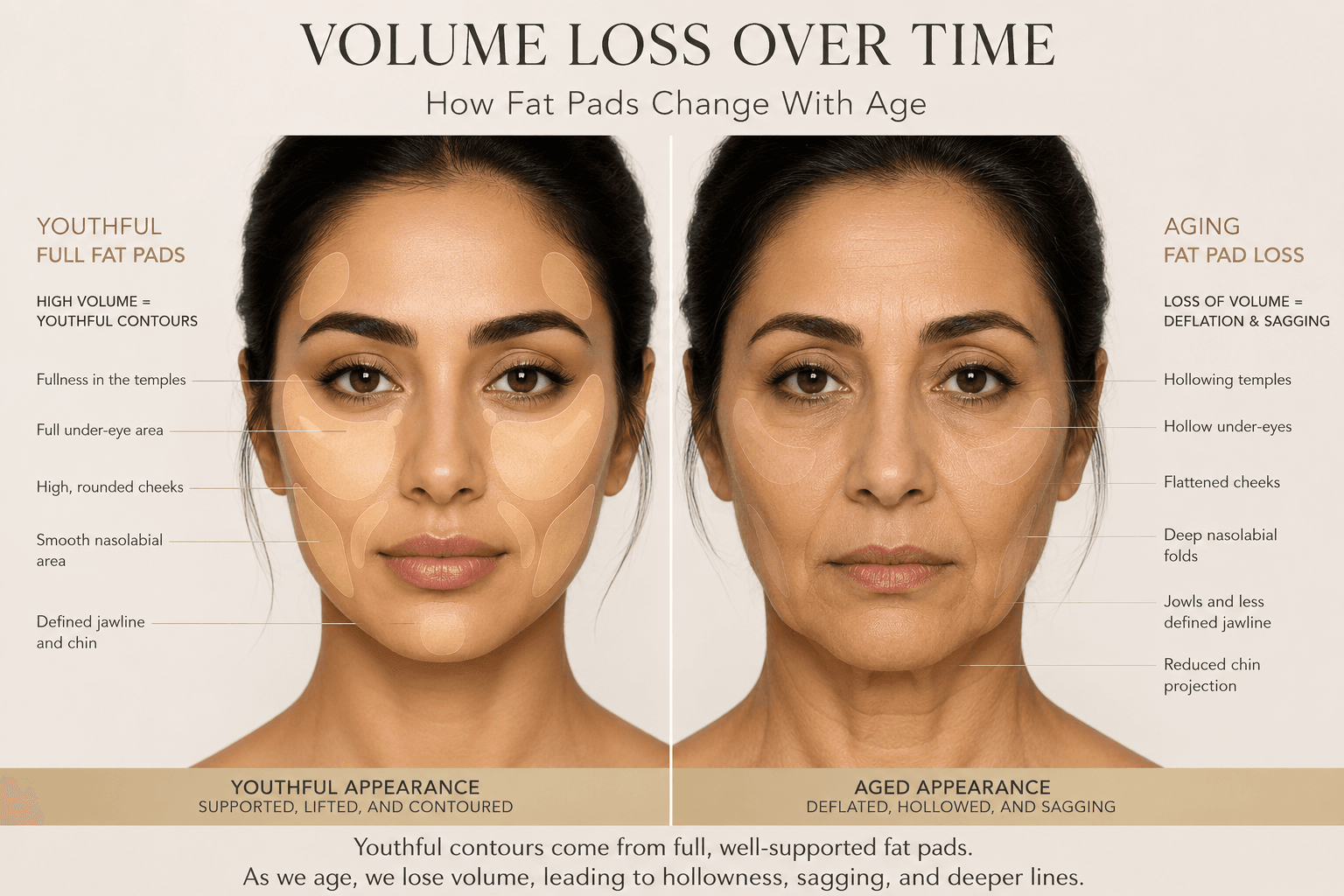
To restore a youthful appearance or enhance a feature beautifully, we must replace missing volume. However, the secret lies in two things: restraint and rheology.
The Science of Rheology: Matching Gel to Layer
Rheology is the study of how a substance flows and deforms under stress. In aesthetic dermatology, fillers are engineered with wildly different rheological properties:
- Elasticity (G′): High G′ fillers are firm and resilient. They behave like structural scaffolding. These must be placed deep on the bone to lift the overlying tissue without spreading out flat.
- Cohesivity: This dictates how well the gel sticks together. High cohesivity allows a filler to move naturally with your expressions without fracturing or looking lumpish under the skin.
If an injector places a soft, highly fluid filler deep on the bone, it won't lift; it will spread out, requiring more volume and creating a puffy look. Conversely, placing a thick, high-G′ filler too superficially creates visible lumps. "Pillow face" happens when the wrong product is placed in the wrong layer, or when the sheer volume injected overwhelms the natural contours of the face.
Myth 3: Fillers Stretch the Skin and Ruin Your Face in the Long Run
The Claim: Continual filler use stretches out your natural tissues, meaning you will need more and more product over time just to avoid looking saggy.
The Reality: When administered with precision, HA fillers do the exact opposite. Clinical studies demonstrate that the mechanical stretching of fibroblasts (the cells responsible for producing collagen) caused by careful HA placement actually stimulates localized, natural Type I collagen production.
Rather than ruining your face, correctly placed filler acts as a supportive matrix that preserves tissue integrity over time. The key is knowing when to stop. A top-tier practitioner does not continuously stack filler layer upon layer every few months. Instead, we use a maintenance approach: letting the product naturally break down, assessing the tissue structure, and micro-dosing small volumes only where true structural deficits exist.
The Golden Rule: The Right Volume in the Right Layer
When done right, HA fillers are an incredible asset to maintain a naturally refreshed, youthful appearance. If you are noticing hollows under the eyes, flattened cheeks, or a softening jawline, replacing that lost structural volume is essential to restoring harmony to your face.
The goal should never be to erase every single line or to change who you look like. The goal is a natural, refined, and undetectable result—one where people notice you look incredibly rested, but no one can tell why.
Achieving this requires a deep medical mastery of facial anatomy, an artistic eye for facial proportions, and an advanced understanding of the science behind the products we choose. If you are considering a treatment, skip the social media commentary and seek out a qualified, board-certified expert who prioritizes tissue health and natural harmony above all else.
Scientific References for Further Reading
- Sundaram, H., et al. Cohesive Polydensified Matrix Hyaluronic Acid Dermal Filler: Mechanics and Clinical Relevance. Dermatologic Surgery.
- Micheels, P., et al. In Vivo Evaluation of the Bio-Integration of Different Hyaluronic Acid Fillers. Journal of Cosmetic Dermatology.
- Quan, T., et al. In Vivo Stimulation of De Novo Collagen Production by Injection of Cross-linked Hyaluronic Acid in Photodamaged Human Skin. Archives of Dermatology.