
Hyaluronic Acid Skin Boosters in Jeddah: Which One Is Right for You? | Dr. Shazia Ali
September 15, 2026
Hyaluronic Acid Skin Boosters: Which One Should You Choose?
If you have ever asked about a skin booster, you may have discovered that the choice is no longer simple.
Some hyaluronic acid (HA) treatments are designed around several initial sessions and regular maintenance. Others use more persistent or stabilized HA technologies, while newer products use cross-linked HA designed to remain within the dermis for longer.
So which one should you choose?
My approach is simple:
Don't choose a skin booster because of the brand name, what is currently trending, or what is considered the most fashionable product. Choose according to your skin, the HA technology, the result you want, and how frequently you are prepared to have treatment.
Let me explain.
What Is a Hyaluronic Acid Skin Booster?
Hyaluronic acid occurs naturally within our skin and plays an important role in hydration and the extracellular matrix.
Injectable HA skin treatments can help improve characteristics such as:
- Hydration
- Texture
- Firmness
- Elasticity
- Radiance
A systematic review of 13 clinical studies found promising evidence for improvement across several measures of facial skin quality following injectable HA treatment.
Skin Booster vs Traditional Filler: What Is the Difference?
This is one of the most common questions I hear.
Although both may contain hyaluronic acid, their purpose can be very different.
A structural HA gel is generally selected when I want to:
- Restore genuine volume loss
- Improve structural support
- Modify facial contour
With a skin booster, our primary objective is different:
We treat the quality of the skin rather than trying to change the shape of the face.
That distinction is especially important for patients who want refreshed, healthy-looking skin without appearing overfilled.
Why Do Some Skin Boosters Last Longer Than Others?
Not all hyaluronic acid is the same.
HA products differ in their:
- Molecular weight
- Concentration
- Stabilization or cross-linking
- Particle characteristics
- Rheology
- Resistance to degradation
These differences influence how a product behaves after injection and how frequently treatment may need to be repeated.
This is why asking "Which skin booster is best?" is often the wrong question.
A better question is:
"Which HA technology is most appropriate for my skin and my treatment goals?"
Think about it this way:
Two creams can both contain vitamin C but behave very differently on your skin.
The same principle applies to injectable HA boosters.
The important question therefore isn't simply:
"Is this hyaluronic acid?"
It is:
"What type of hyaluronic acid is it, how has it been formulated, where is it being placed, and what are we trying to achieve?"
The Evolution of HA Skin Boosters
Over the years, we have seen skin-booster treatments evolve considerably.
For patients, I find it easiest to think about them in three broad generations.
Generation 1: The Traditional Skin-Booster Approach
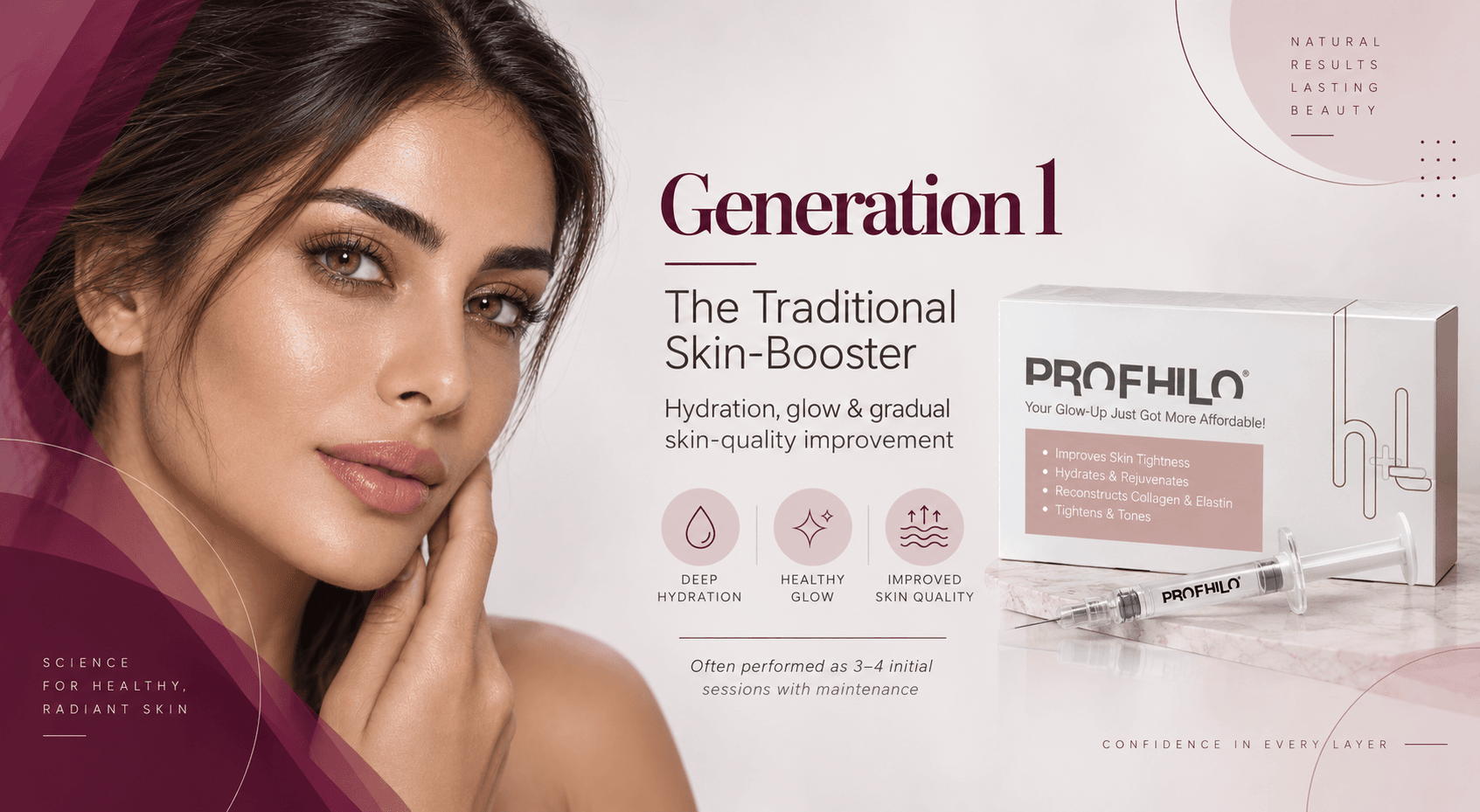
These treatments introduced the concept of injectable hydration and bio-revitalisation.
They usually last approximately one month within the skin.
They are often performed as an initial course of 3–4 treatments, followed by maintenance sessions.
This approach can be suitable for patients who:
- Are comfortable returning periodically
- Prefer gradual skin-quality improvement
- Want hydration and bio-revitalisation
Profhilo is one of the best-known HA bio-remodelling treatments, although it is technically different from conventional mesotherapy-style skin boosters.
For example, Profhilo contains stable hybrid cooperative complexes of high- and low-molecular-weight HA rather than conventional chemically cross-linked HA.
Generation 2: More Persistent HA Skin-Quality Treatments
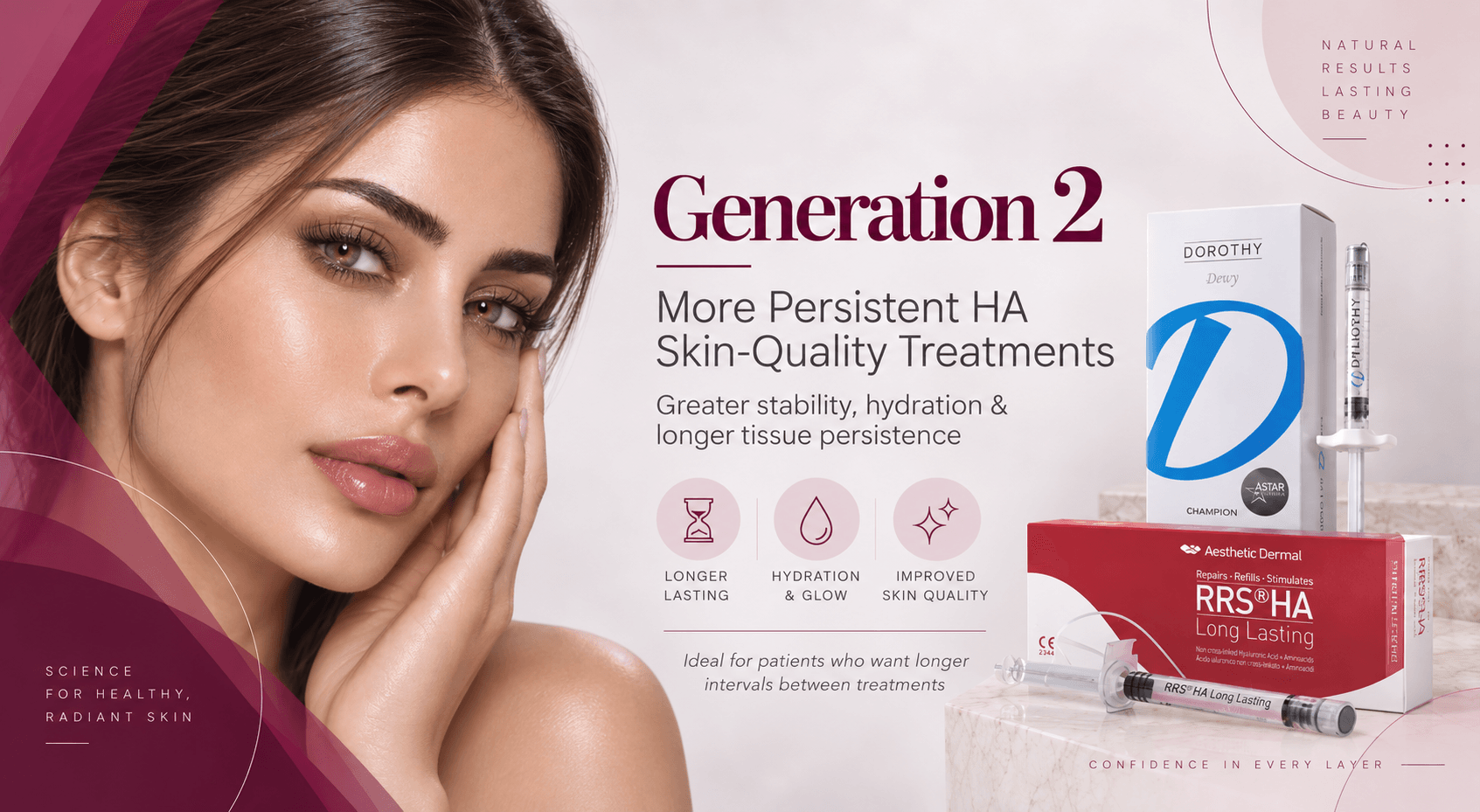
As HA technology evolved, products were developed with greater stability and tissue persistence, which can last approximately 2–3 months within the skin.
These treatments can be attractive for patients seeking hydration and skin-quality improvement but who would prefer longer intervals between treatments.
The important difference is therefore not simply the brand.
It is how the HA has been formulated and how it behaves within the tissue.
Examples of products that may fall into this broader conversation include:
- Dorthy
- RRS
- Other stabilized HA injectable treatments
If HA remains within the dermal environment for longer, theoretically we can maintain the skin-quality effect without repeatedly re-injecting the patient every few weeks.
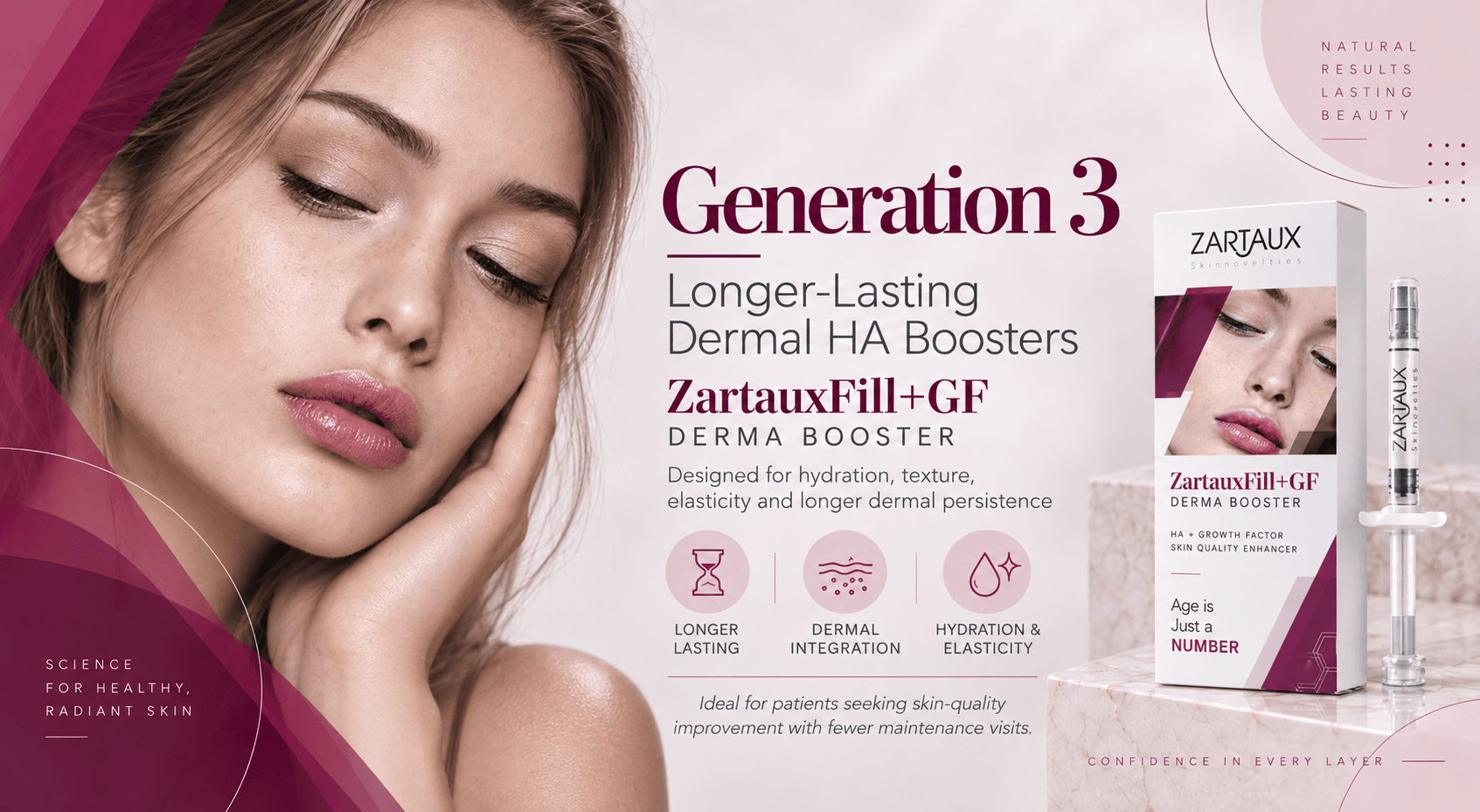
Generation 3: Longer-Lasting Dermal HA Boosters
This is the area I find particularly interesting today.
Newer HA technologies are being developed specifically around greater stability and longer tissue residence — potentially 6–8 months — while still focusing on skin quality rather than facial volumization.
One example is ZartauxFill+GF DERMA BOOSTER.
Unlike a simple non-cross-linked HA solution, it uses cross-linked HA micro-spheres designed for intra-dermal integration.
The treatment is intended to address features such as:
- Skin hydration
- Texture
- Elasticity
- Radiance
- Skin density
- Mild textural irregularities
- Natural collagen and elastin formation
The attraction of this newer approach is straightforward:
Can we achieve the benefits we want from a skin booster while reducing how frequently the patient needs to be treated?
For many of my patients, this is becoming increasingly important.
My Skin-Booster Roadmap
When a patient asks me which skin booster she should choose, these are the questions I consider.
1. Do You Mainly Want Hydration and Glow?
If your skin is relatively healthy but looks tired, dehydrated, or dull, a lighter HA-based treatment may be perfectly adequate.
You may not need the longest-lasting or most sophisticated product available.
2. Is Your Problem More About Texture and Skin Quality?
If you are noticing:
- Fine lines
- Crepiness
- Reduced elasticity
- More significant deterioration in skin quality
I may prefer a treatment designed to remain within the dermal environment for a longer duration.
3. How Often Are You Willing to Come to the Clinic?
This is surprisingly important.
Some patients enjoy having regular treatments.
Others tell me:
"Doctor, I want something effective, but I don't want to come every month."
For these patients, longer-lasting HA technologies become particularly attractive.
4. Do You Actually Need a Skin Booster — or Something Else?
Not every ageing face needs more hyaluronic acid.
Sometimes the real problem is:
- Pigmentation
- Acne scarring
- Vascular damage
- Significant laxity
- Loss of deep structural support
- Muscle-related lines
- True volume loss
A skin booster cannot correct all of these problems.
Sometimes the more appropriate treatment may be:
- Laser treatment
- Energy-based treatment
- Neuro-modulation
- Regenerative treatment
- Collagen stimulation
- Carefully selected structural HA gel
And sometimes we combine treatments.
Quick Comparison: Which Category Sounds Most Like You?
I Want Hydration and Glow and Don't Mind Several Sessions
A traditional HA skin-booster or bio-remodelling protocol may be appropriate.
I Want Better Skin Quality but Would Prefer Fewer Maintenance Visits
A more persistent or stabilized HA treatment may make more sense.
I Want Hydration, Texture and Elasticity Improvement — and Longevity Is Particularly Important to Me
A newer-generation, longer-lasting dermal HA booster may be worth discussing.
My Face Looks Hollow, Saggy or Structurally Different
Do not automatically book a skin booster.
You may require a completely different treatment strategy.
I Have Pigmentation, Melasma, Acne Scars or Enlarged Pores
A skin booster may be part of your treatment plan, but it is unlikely to be the entire treatment.
How Long Should a Skin Booster Last?
This is the question everyone asks — and unfortunately, there is no single number.
Longevity depends on:
- The HA formulation
- Whether and how the HA has been stabilized or cross-linked
- Concentration and rheological characteristics
- Injection depth
- Treatment area
- Amount used
- Individual metabolism
- Age and baseline skin quality
- Lifestyle and environmental factors
This is why I am cautious when someone promises that every patient will obtain an exact number of months from an injectable treatment.
Product longevity is a range, not an expiry date.
The skin also doesn't suddenly return to its starting point on a particular day.
Results gradually change as the injected HA is metabolized and the biological effects of treatment evolve.
What About ZartauxFill Dermabooster?
This is one of the newer HA technologies I have been exploring because its concept is different from the traditional short-duration skin-booster model.
ZartauxFill Dermabooster uses stabilized, cross-linked HA microsphere technology designed for dermal integration rather than conventional facial volumization.
For the appropriate patient, the attraction is the possibility of combining:
Hydration + skin-quality improvement + greater persistence
while maintaining the philosophy of treating the skin rather than simply adding facial volume.
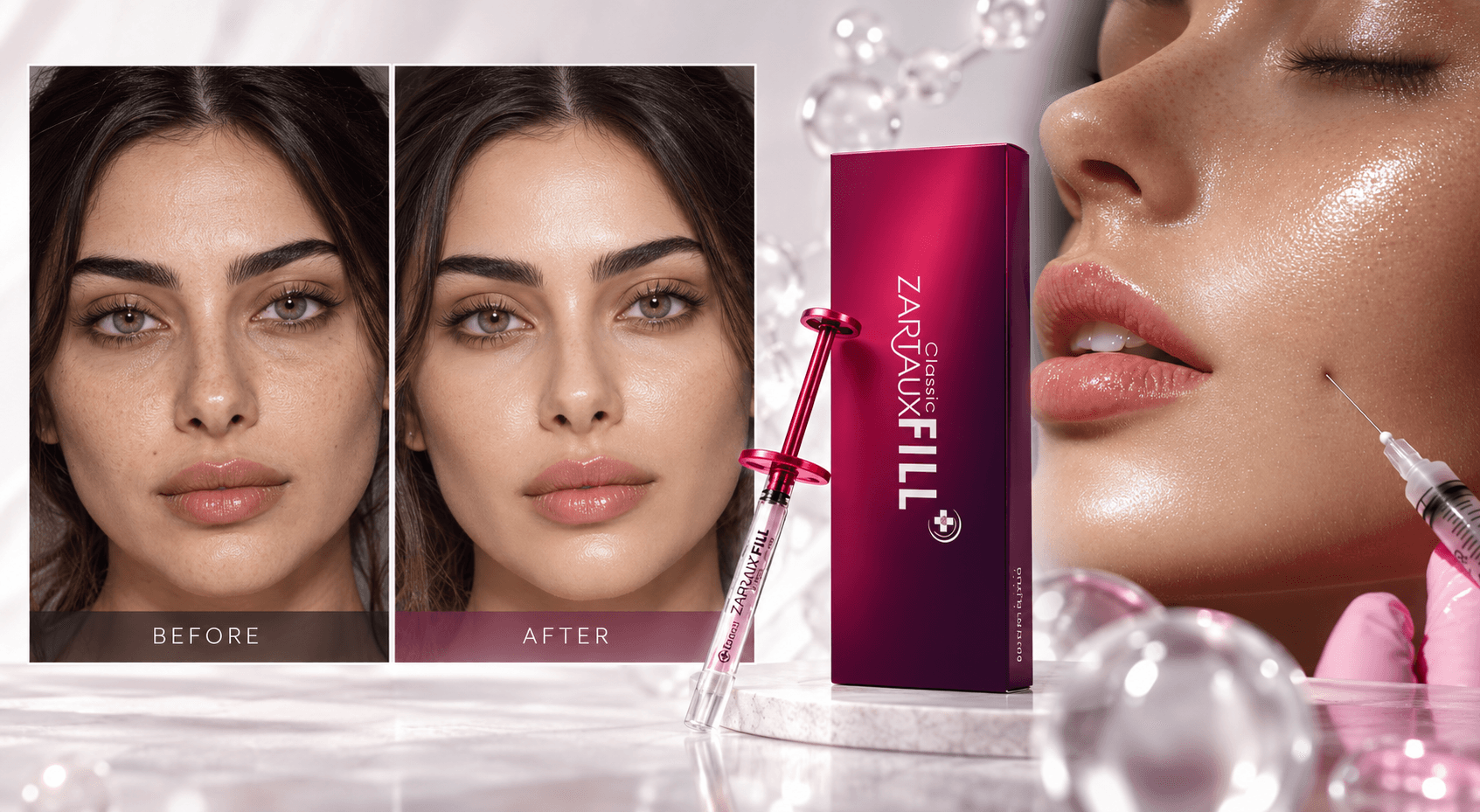
I find this direction particularly interesting because aesthetic medicine is moving away from the old idea that patients need to constantly add more product.
My preference is increasingly:
Treat intelligently. Treat precisely. And treat only as often as necessary.
Will a Skin Booster Make My Face Look Puffy or Overfilled?
A properly selected and correctly injected skin-quality treatment should not be chosen with the intention of changing your facial identity.
This is particularly important to me.
I don't believe that ageing automatically means that a face needs more volume.
My approach is always to separate:
- Structure
- Volume
- Skin quality
- Laxity
- Movement
- Facial proportion
If the problem is skin quality, I treat skin quality.
If there is genuine structural deficiency, I address structure.
If the problem is movement, I treat movement.
The treatment should follow the diagnosis — not the other way around.
Which Skin Booster Would I Choose?
There isn't one skin booster that I would choose for every patient.
Instead, I would ask:
- How old is the skin?
- How dehydrated is it?
- How much elasticity has been lost?
- What is the texture like?
- Which area are we treating?
- How long do we want the result to persist?
- How frequently does this patient realistically want treatment?
Only after answering those questions would I choose the HA technology.
That is why two friends of the same age may come to my clinic and leave with completely different treatment plans.
The Bottom Line
Skin boosters have evolved.
We have moved from treatments that relied heavily on repeated injection sessions toward increasingly sophisticated HA technologies designed to remain within the dermis for longer.
But the future of skin boosting is not simply about making HA last longer.
It is about becoming more selective.
The right product.
The right skin.
The right depth.
The right amount.
And the right interval between treatments.
If you are considering a skin booster, don't begin by asking:
"Which brand is best?"
Begin with:
"What exactly is wrong with my skin — and what am I trying to improve?"
Once we answer that question, choosing the treatment becomes much easier.
Frequently Asked Questions About Skin Boosters
What Is the Best Skin Booster for Glowing Skin?
There is no universal "best" skin booster.
Younger or mildly dehydrated skin may respond beautifully to a lighter HA treatment, while more mature or significantly dehydrated skin may benefit from a more persistent HA formulation.
Are Skin Boosters the Same as Fillers?
No. Although both may contain hyaluronic acid, their treatment objectives can be very different.
Skin boosters primarily target skin quality, while traditional dermal fillers are commonly used for structural support, contouring, or volume restoration.
Can Skin Boosters Make My Face Look Unnatural?
The intention of a skin-quality treatment should not be to dramatically alter facial proportions.
Product choice, quantity, injection depth, and technique all matter.
How Many Skin-Booster Sessions Do I Need?
It depends on the product. Some treatments are designed around an initial course of sessions followed by maintenance, while more persistent HA technologies may allow longer intervals.
Your treatment plan should follow the manufacturer's approved protocol and your physician's assessment.
Can I Have a Skin Booster Before an Event?
Yes, but not immediately before an important event.
Injection-related:
- Redness
- Swelling
- Small bumps
- Bruising
can occur.
Allow adequate time for the skin to settle.
At What Age Should I Start Skin Boosters?
There is no correct age.
Treatment should be based on skin condition rather than your birthday.
Some patients in their 30s mainly require hydration, while others later in life may require treatment for elasticity, texture, and more complex ageing changes.
Are Longer-Lasting Skin Boosters Better Value?
Potentially — particularly for patients who require fewer treatment visits — but price per syringe should not be the only consideration.
The relevant comparison is the total treatment plan over six to twelve months, including the number of sessions required.
Can Skin Boosters Replace Lasers or Other Treatments?
No. HA cannot correct every skin problem.
Conditions such as:
- Pigmentation
- Vascular changes
- Significant laxity
- Acne scarring
- Enlarged pores
- Other structural or skin-quality concerns
may require different treatments or combination therapy.
References & Further Reading
-
Ghatge AS, Ghatge SB. The Effectiveness of Injectable Hyaluronic Acid in the Improvement of the Facial Skin Quality: A Systematic Review. Clinical, Cosmetic and Investigational Dermatology. 2023;16:891–899. doi:10.2147/CCID.S404248. This systematic review evaluated 13 clinical studies and found promising evidence for improvements in hydration, firmness, brightness, texture, radiance and elasticity following injectable HA treatments.
-
Zhou R, Yu M. The Effect of Local Hyaluronic Acid Injection on Skin Aging: A Systematic Review and Meta-Analysis. Journal of Cosmetic Dermatology. 2025;24(1). doi:10.1111/jocd.16760. A systematic review and meta-analysis examining injectable HA for wrinkles, elasticity, hydration and other measures of skin ageing.
-
Ayatollahi A, Firooz A, Samadi A. Evaluation of safety and efficacy of booster injections of hyaluronic acid in improving the facial skin quality. Journal of Cosmetic Dermatology. 2020. doi:10.1111/jocd.13493. Participants received three treatments of non-cross-linked HA at three-week intervals, with improvements in several measures of skin firmness and elasticity still demonstrated four months after treatment.
-
Kerscher M, et al. Injectable Non-Animal Stabilized Hyaluronic Acid as a Skin Quality Booster: An Expert Panel Consensus. Journal of Drugs in Dermatology. 2017. The expert panel discusses stabilised HA skin boosters, initial treatment courses and subsequent maintenance schedules, illustrating why treatment frequency varies considerably between HA technologies.
-
Cheng SWN, Lim SYD, Cigni C, et al. Efficacy and Tolerability of Stable Hybrid Cooperative Complexes of High- and Low-Molecular Weight Hyaluronic Acid in Asian Patients: An Open-Label Study. Aesthetic Plastic Surgery. 2026;50:27–36. doi:10.1007/s00266-025-05188-x. This study evaluated Profhilo in Asian female patients following treatments at weeks 0 and 4 and reported significant improvements in superficial skin hydration and transepidermal water loss at follow-up.
-
Sparavigna A, et al. Efficacy and tolerance of an injectable medical device containing stable hybrid cooperative complexes of high- and low-molecular-weight hyaluronic acid: a monocentric 16 weeks open-label evaluation. Clinical, Cosmetic and Investigational Dermatology. 2016. This clinical study describes Profhilo's stable hybrid cooperative complexes of high- and low-molecular-weight HA and evaluates its effects on ageing skin.
-
A Systematic Review of the Efficacy and Safety of Profhilo® and Profhilo® Body. 2026. This systematic review included nine studies and 278 participants and assessed outcomes including hydration, elasticity, density, laxity and wrinkle severity.
-
The efficacy of intradermal hyaluronic acid filler as a skin quality booster: a prospective, single-center, single-arm pilot study. This prospective study evaluated an intradermally injected HA gel and demonstrated improvements across several measures including wrinkles, roughness, elasticity, pore size, hydration and glossiness.
-
Intradermal "Skin Boosters": Are We Targeting Too Superficially? Journal of Cosmetic Dermatology. 2026;25. doi:10.1111/jocd.70906. A recent discussion of the evolving definition of skin boosters, including non-cross-linked and lightly cross-linked HA formulations and the importance of injection plane when targeting skin quality.
Dr. Shazia Ali Dermatologist & Aesthetic Physician TrueMe Medical Center Jeddah, Saudi Arabia
This article is intended for patient education and does not replace an individual medical assessment. Injectable treatments should be performed by appropriately qualified medical professionals using products approved for use in the relevant country.