
Laser Hair Reduction in the Middle East: Navigating Skin Phototypes, Wavelengths & Safety
August 15, 2026
Laser Hair Removal for Middle Eastern Skin: Which Laser Is Safest and Most Effective?
Laser hair removal for Middle Eastern skin can be highly effective, but the laser wavelength, treatment settings, cooling system and experience of the medical team matter enormously.
Many people in Saudi Arabia have a combination of olive, light-brown or deeply pigmented skin with dark, coarse hair. This combination can respond extremely well to medical laser hair removal. However, skin containing more melanin may also be more vulnerable to burns, irritation and post-inflammatory hyperpigmentation when an unsuitable laser or incorrect settings are used.
At TrueMe Medical Center in Jeddah, laser hair removal is performed using the Candela Gentle Pro Series, including:
- GentleLase Pro: A standalone 755 nm Alexandrite laser, purpose-built for high-speed hair removal on lighter skin and the treatment of selected superficial pigmentation.
- GentleYag Pro: A standalone 1064 nm Nd:YAG laser, configured to penetrate more deeply and reduce unnecessary absorption by melanin in darker skin.
- Candela Gentle Pro Series: A medical laser platform that provides both the 755 nm Alexandrite and 1064 nm Nd:YAG wavelengths, allowing treatment to be adapted for different skin tones and hair types.
Having access to both wavelengths means the laser can be selected according to the patient’s actual skin colour, recent sun exposure, hair thickness, treatment area and pigmentation risk rather than applying the same protocol to everyone.
Laser hair removal is more accurately described as producing long-term or permanent hair reduction, rather than guaranteeing that every hair will disappear forever.
Multiple treatment sessions are required because the laser is most effective when hairs are in the active stage of their growth cycle.
Why Does Middle Eastern Skin Require a More Careful Approach?
Laser hair removal works through a process known as selective photothermolysis.
The laser produces light at a specific wavelength. This light is absorbed by melanin inside the hair shaft and hair follicle. The light energy is then converted into heat, damaging the structures responsible for producing new hair.
The challenge is that melanin is also present in the surface layers of the skin.
When there is a strong contrast between light skin and dark hair, the laser can distinguish the hair follicle relatively easily. In olive, brown, deeply pigmented or recently tanned skin, some laser energy may also be absorbed by epidermal melanin.
If the wavelength, energy, pulse duration or cooling is inappropriate, this can increase the risk of:
- Excessive redness
- Prolonged skin irritation
- Superficial burns
- Blistering
- Temporary darkening of the skin
- Temporary lightening of the skin
- Post-inflammatory hyperpigmentation
- Rarely, scarring
This does not mean that darker skin cannot be treated safely.
It means that darker skin should be treated using the correct wavelength, carefully selected treatment settings and effective epidermal cooling.
The long-pulsed 1064 nm Nd:YAG laser penetrates more deeply and interacts less strongly with surface melanin than shorter wavelengths. It is therefore usually preferred for patients with darker skin phototypes.
The 755 nm Alexandrite laser is absorbed more strongly by melanin and is generally most suitable for lighter, untanned skin with dark hair.
Alexandrite or Nd:YAG: Which Laser Is Better?
There is no single laser that is best for every Middle Eastern patient.
The more appropriate question is:
Which laser wavelength is safest and most effective for my current skin colour, hair type and treatment area?
GentleLase Pro: 755 nm Alexandrite Laser
The GentleLase Pro is a standalone 755 nm Alexandrite laser.
Alexandrite laser energy is strongly absorbed by melanin, allowing it to target dark hair efficiently when the surrounding skin is relatively light.
It is generally most suitable for:
- Fitzpatrick skin types I–III
- Fair to light-olive skin
- Untanned skin
- Dark, clearly visible hair
- Large body areas requiring efficient treatment
- Patients with a strong contrast between their skin and hair colour
- Selected areas containing finer but still visibly pigmented hair
Alexandrite treatment may produce rapid and effective hair reduction in an appropriately selected patient.
However, because this wavelength is strongly attracted to melanin, it must be used cautiously—or avoided—when the skin is darker, recently tanned or significantly sun-exposed.
GentleYag Pro: 1064 nm Nd:YAG Laser
The GentleYag Pro is a standalone 1064 nm Nd:YAG laser.
Its longer wavelength penetrates more deeply into the skin and is absorbed less strongly by surface melanin.
It is generally preferred for:
- Fitzpatrick skin types IV–VI
- Olive skin
- Brown skin
- Deeply pigmented skin
- Coarse, deeply rooted hair
- Bikini and intimate areas
- Underarm hair
- Male beard and neck hair
- Male body hair
- Patients prone to pigmentation after inflammation
- Patients with a history of laser-related burns or pigmentation changes
The Nd:YAG wavelength helps the laser reach the deeper hair follicle while reducing unnecessary heating of the skin surface.
This lowers—but does not completely eliminate—the risk of burns and pigmentation changes.
Why Having Both Laser Wavelengths Matters
Middle Eastern skin cannot be placed into one single category.
Two patients may both describe themselves as having “olive skin,” yet one may be suitable for Alexandrite while the other requires Nd:YAG.
The same patient may even need different treatment decisions at different times of the year.
For example:
- A light-skinned patient may be suitable for Alexandrite during winter.
- The same patient may require Nd:YAG or postponement after significant summer sun exposure.
- The face may require different settings from the legs.
- The bikini area may be considerably darker than the abdomen.
- The underarms may require different parameters from the arms.
- Fine facial hair should not be treated in the same way as coarse underarm hair.
- Male beard hair may require a different approach from male back or chest hair.
The Candela Gentle Pro Series provides access to both the 755 nm Alexandrite and 1064 nm Nd:YAG technologies.
This allows the treatment team to match the wavelength to the individual patient rather than attempting to treat everyone with the same machine.
Why Is Cooling Important During Laser Hair Removal?
Cooling is not only used for comfort.
It also helps protect the surface of the skin while the laser energy travels toward the deeper hair follicle.
The Candela Gentle Pro platform incorporates a Dynamic Cooling Device, which delivers a precisely timed burst of cooling spray around the laser pulse.
This can help:
- Protect the epidermis
- Reduce discomfort
- Limit unnecessary surface heating
- Reduce the risk of burns
- Allow more controlled energy delivery
- Improve the overall treatment experience
However, cooling does not compensate for an unsuitable wavelength or incorrect treatment settings.
The wavelength, energy, pulse duration, spot size, cooling and treatment technique must all work together.
Is Laser Hair Removal Safe for Brown or Dark Skin?
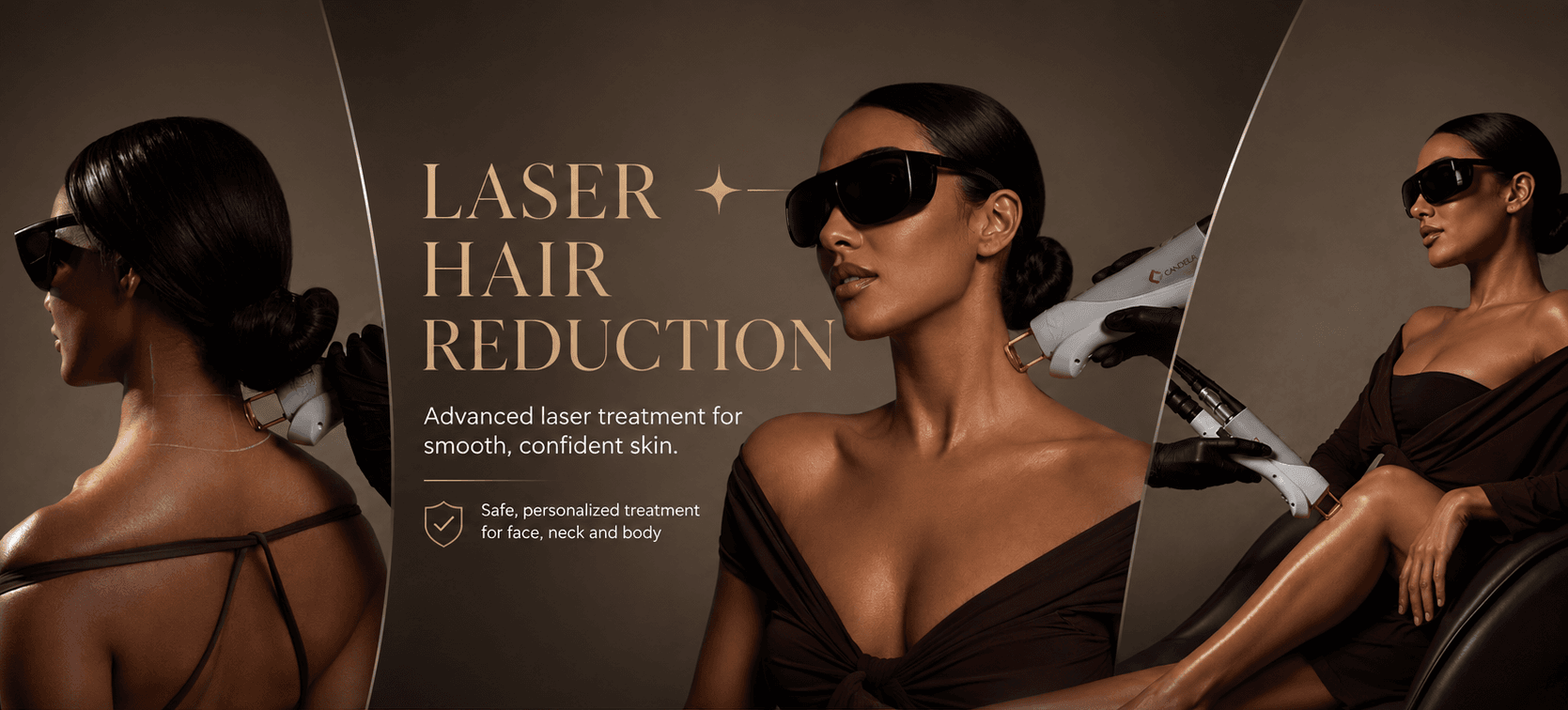
Yes. Laser hair removal can be performed safely on brown and dark skin when:
- The correct wavelength is selected
- The practitioner understands skin of colour
- The energy is adjusted appropriately
- The pulse duration is suitable
- Effective skin cooling is used
- Recent tanning is considered
- Sun exposure is discussed honestly
- The treatment area is examined carefully
- A test area is performed when clinically indicated
- The patient follows pre-treatment and aftercare instructions
For many darker-skinned patients, the 1064 nm Nd:YAG laser is the preferred option because it is less strongly absorbed by epidermal melanin.
However, the name of the machine alone is not enough.
A high-quality medical laser can still cause complications when used with inappropriate settings or on an unsuitable patient.
Is Laser Hair Removal Safe for Tanned Skin?
Recently tanned skin contains more active epidermal melanin.
This gives the laser an additional target and increases the possibility of excessive heating at the skin surface.
Patients should always disclose:
- Recent beach exposure
- Poolside sun exposure
- Sunbathing
- Outdoor exercise
- A recent holiday
- Tanning-bed use
- Self-tanning products
- Darkening after prolonged driving
- Outdoor work
- Recent sunburn
A tan may not always look dramatic, especially on naturally olive skin. Even a subtle change in skin colour may influence the treatment decision.
Depending on the degree of tanning, the session may need to be:
- Modified
- Performed using a safer wavelength
- Conducted at more conservative settings
- Limited to a test area
- Postponed until the tan has faded
Never hide recent sun exposure because you do not want your appointment to be delayed. Protecting the skin is more important than keeping the original treatment date.
How Many Laser Hair Removal Sessions Will I Need?
Most patients require approximately six to eight initial treatment sessions, although some may need fewer and others may require more.
The total number of sessions depends on:
- The treatment area
- Hair thickness
- Hair colour
- Skin colour
- Hair density
- The hair-growth cycle
- Hormonal influences
- Previous waxing or laser treatment
- The laser wavelength
- Treatment settings
- Consistency of appointments
- Individual biological response
- Whether maintenance treatment is required
The face, underarms, bikini area, legs, chest and back do not all follow the same growth cycle.
Appointment intervals should therefore be adjusted according to the treatment area rather than automatically scheduling every patient at the same interval.
Why Can’t All the Hair Be Removed in One Session?
Hair grows in different stages.
The main stages of the hair-growth cycle are:
- Anagen: The active growth phase
- Catagen: The transitional phase
- Telogen: The resting phase
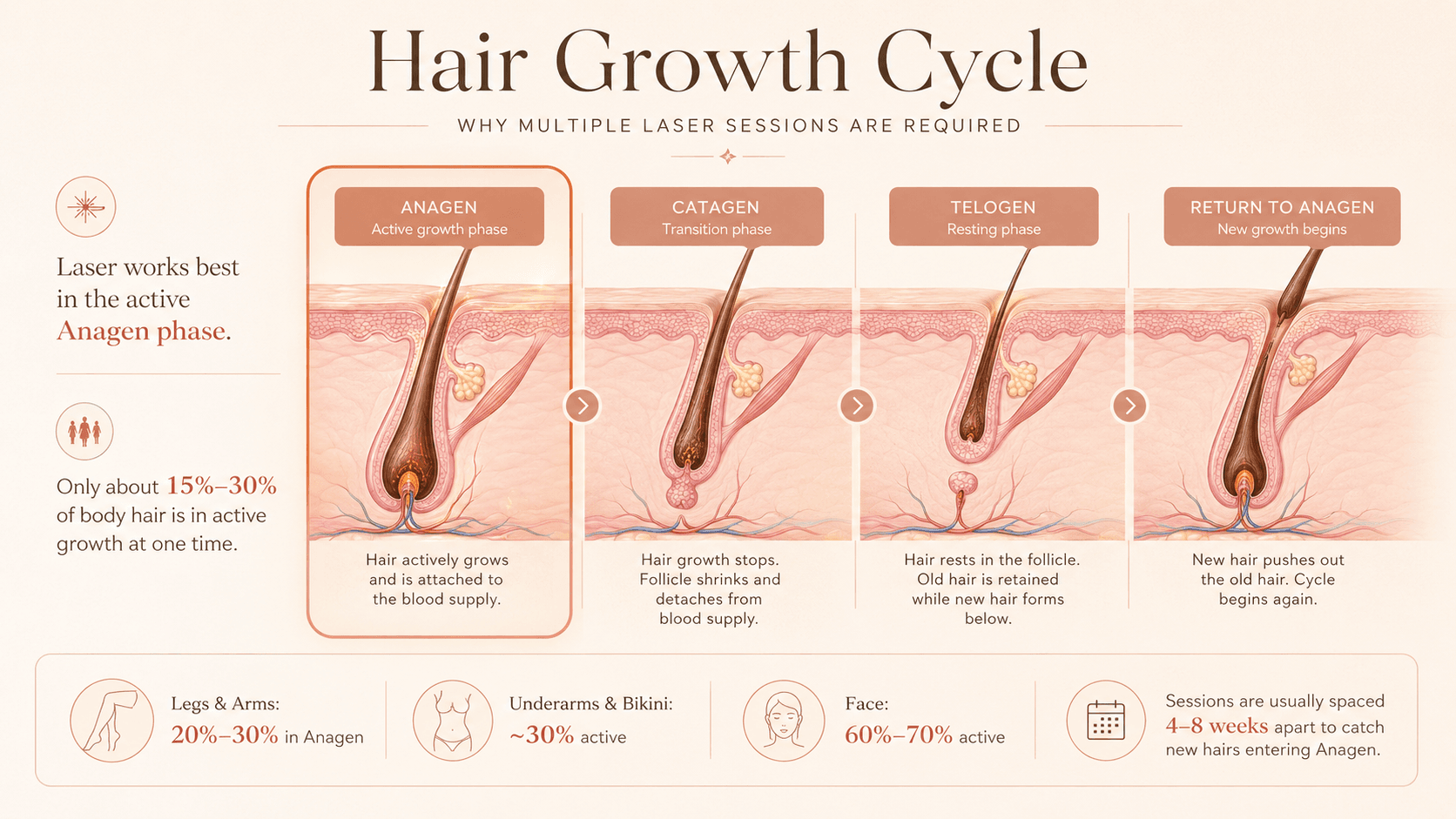
Laser treatment is most effective during the anagen phase, when the hair is actively connected to the structures responsible for producing new growth.
At any particular time, only a proportion of hairs are in this active phase.
Other hairs may be resting, shedding or moving between stages.
This is why repeated treatment sessions are necessary.
Treating too frequently does not automatically produce faster results. It may simply expose the skin again before enough new hairs have entered the appropriate growth stage.
Is Laser Hair Removal Permanent?
Laser treatment is best described as producing permanent or long-term hair reduction.
After a successful treatment course, patients commonly notice:
- Fewer hairs
- Slower regrowth
- Finer regrowth
- Softer hair texture
- Patchier hair distribution
- Less frequent shaving
- Less irritation from shaving
- Fewer ingrown hairs
- Less inflammation
- Improvement in some shaving-related dark marks
Some follicles may recover over time.
New hair may also develop because of:
- Hormonal changes
- Pregnancy
- Polycystic ovary syndrome
- Age-related hormonal changes
- Menopause
- Medication
- Weight changes
- Genetic factors
Maintenance sessions may therefore be required.
Some patients may need one or two maintenance sessions per year, while others may go much longer between treatments.
Does Laser Hair Removal Work on Fine Facial Hair?
Laser works most predictably on dark, coarse terminal hair.
Very fine facial hair, often called peach fuzz or vellus hair, contains less pigment and may not absorb enough laser energy to be treated effectively.
Attempting to treat large areas of very fine facial hair may produce disappointing results.
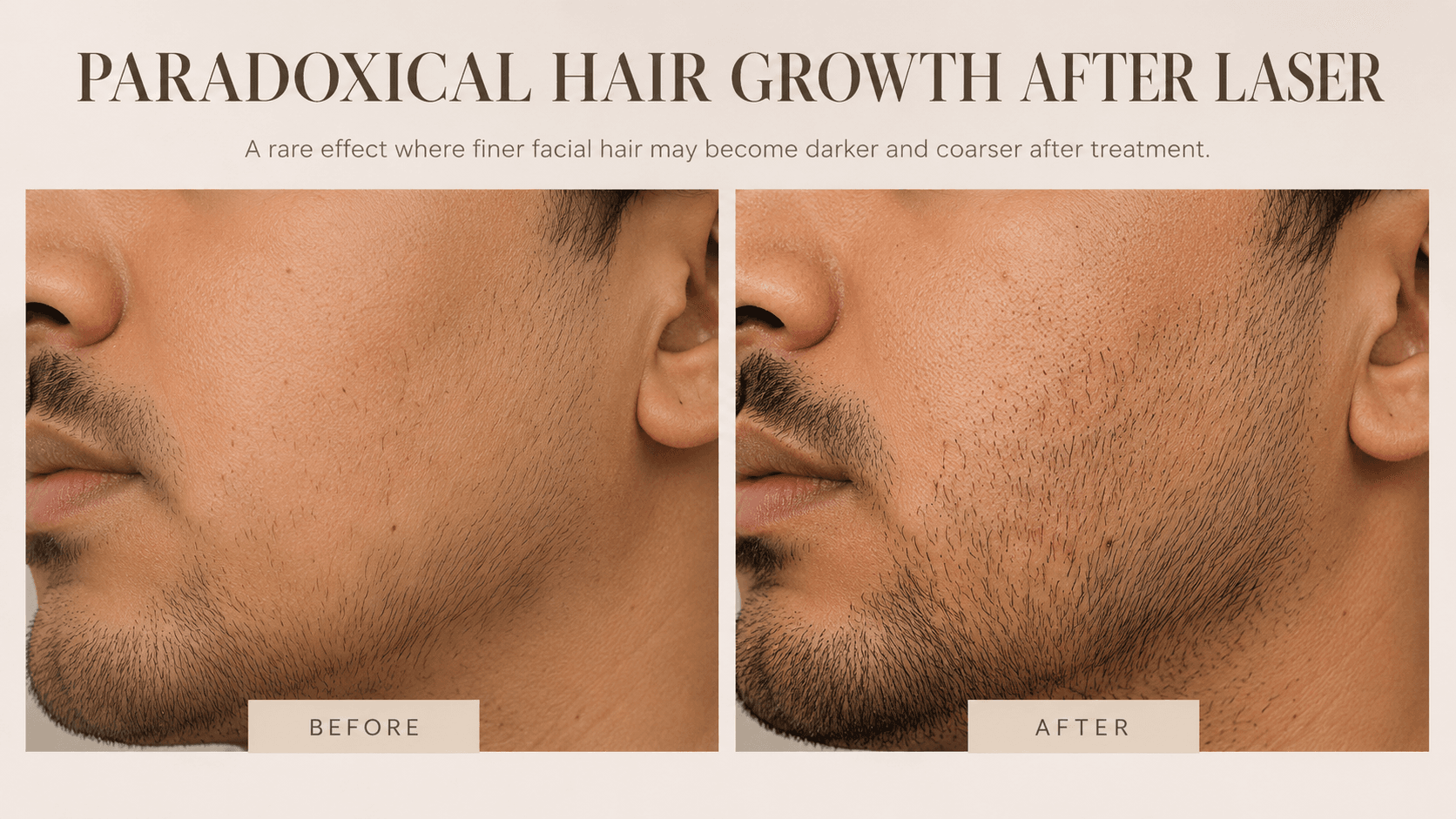
In susceptible patients, it may also contribute to paradoxical hair growth, where the hair becomes denser or coarser after treatment.
The face and neck require especially careful assessment in Middle Eastern women because these areas may contain a mixture of:
- Thick hormonal hair
- Fine vellus hair
- Intermediate hair
- Hair affected by threading
- Hair affected by waxing
- Hair associated with PCOS
- Hair extending beyond the original treatment zone
- Dark hairs mixed with very fine hairs
A responsible consultation may conclude that some hairs should not be treated with laser.
Can Laser Hair Removal Cause More Hair Growth?
Rarely, laser or intense pulsed light treatment can cause paradoxical hypertrichosis.
This means that the hair becomes:
- Denser
- Darker
- Coarser
- More widespread
- More visible around the treated area
This complication is reported most commonly on the:
- Face
- Neck
- Jawline
- Upper cheeks
- Sideburn area
Potential risk factors may include:
- Fine facial hair
- Intermediate facial hair
- Darker skin phototypes
- PCOS
- Menstrual irregularity
- Hormonal imbalance
- Treating overly broad facial areas
- Treating areas surrounding the coarse hairs
- Inadequate laser energy
- Inappropriate wavelength selection
- Poor sun protection
- Repeated low-energy treatments
This does not mean that every patient with PCOS or darker skin will experience increased hair.
It means that facial laser treatment requires careful diagnosis, counselling and precise selection of the treatment area.
What If I Have PCOS or Hormonal Facial Hair?
Laser can significantly reduce coarse, dark hair associated with polycystic ovary syndrome, but it does not treat the underlying hormonal stimulus.
A medical assessment should be considered when facial or body hair is accompanied by:
- Irregular periods
- Absent periods
- Persistent acne
- Scalp hair thinning
- Sudden facial-hair growth
- Rapidly increasing body hair
- Weight gain
- Difficulty losing weight
- Difficulty becoming pregnant
- Darkening around the neck
- Darkening under the arms
- A known diagnosis of PCOS
- Insulin resistance
Laser can reduce existing coarse hairs, but hormonal activity may stimulate new follicles over time.
Patients with PCOS may therefore require:
- More initial sessions
- Longer-term maintenance
- More careful facial treatment planning
- Treatment limited to genuinely coarse hairs
- Dermatological assessment
- Gynaecological assessment
- Endocrinological investigation
- Medical treatment for the underlying hormonal condition
Laser treatment and hormonal management can complement each other.
One does not necessarily replace the other.
Does Laser Work on Blonde, Red, Grey or White Hair?
Laser hair-removal systems target melanin inside the hair.
Hair containing very little or no melanin does not provide an adequate target.
Laser treatment is therefore usually ineffective for:
- White hair
- Grey hair
- Very pale blonde hair
- Some shades of red hair
Electrolysis may be a more suitable option for individual light-coloured hairs because it does not depend on melanin in the same way.
Dark hair generally responds best, but colour alone is not enough.
Very fine dark hair may still be a poor laser target.
Is Laser Better Than IPL?
A medical laser produces a specific wavelength.
IPL, or intense pulsed light, produces a broader spectrum of light filtered across a range of wavelengths.
IPL may reduce hair in selected patients, but it should not automatically be considered equivalent to a dedicated medical Alexandrite or Nd:YAG laser.
For Middle Eastern and darker skin, precise wavelength selection is particularly important.
The 755 nm Alexandrite laser and the 1064 nm Nd:YAG laser behave differently within the skin.
This allows the practitioner to select the wavelength that is more appropriate for the patient’s:
- Skin colour
- Hair colour
- Hair thickness
- Hair depth
- Treatment area
- Pigmentation risk
- Recent sun exposure
Can Home IPL Devices Replace Medical Laser Hair Removal?
Home IPL devices generally use lower energy than professional medical systems.
They may produce temporary hair reduction in selected skin and hair combinations, but results vary considerably.
Potential limitations include:
- Lower energy delivery
- Less precise skin assessment
- Inconsistent technique
- Limited suitability for darker skin
- Difficulty identifying unsuitable facial hair
- Risk of treating pigmented lesions or moles
- No medical evaluation of hormonal hair growth
- No professional adjustment when the hair becomes finer
- Limited cooling
- Less control over pulse duration and treatment parameters
Patients with darker skin, facial hair, pigmentation disorders, PCOS or a history of laser complications should be particularly cautious about self-treatment.
Does Laser Hair Removal Hurt?
Most patients describe the sensation as:
- Brief heat
- Tingling
- A small elastic-band snap
- A quick pinching sensation
Discomfort varies according to:
- The treatment area
- Hair density
- Hair thickness
- The energy required
- Menstrual sensitivity
- Individual pain threshold
- The cooling method
- Whether the area was shaved correctly
The bikini area, upper lip, ankles and areas containing dense coarse hair may feel more sensitive.
A treatment that is completely painless is not automatically more effective.
However, severe or escalating pain should not be accepted as normal.
Patients should communicate unexpected discomfort immediately so the settings and skin response can be reassessed.
Should I Shave Before Laser Hair Removal?
Yes.
In most cases, the treatment area should be carefully shaved before the session according to the clinic’s instructions.
Shaving removes the visible hair above the skin while preserving the hair shaft and follicle beneath the surface.
This allows laser energy to travel toward the follicle without unnecessarily heating long hair above the skin.
Do not repeatedly pass a razor over irritated skin.
Inform the clinic if shaving has caused:
- Cuts
- Razor burn
- Active folliculitis
- Significant redness
- Skin irritation
Why Must I Stop Waxing, Threading or Plucking?
Waxing, threading, sugaring and tweezing remove the hair from the follicle.
If the target hair is absent, the laser has little or nothing to heat.
Patients are therefore usually advised to stop root-removal methods before beginning laser and between sessions.
Methods to avoid include:
- Waxing
- Threading
- Sugaring
- Tweezing
- Epilation devices
Shaving is generally permitted because it leaves the follicular target in place.
The recommended interval depends on the area and the patient’s hair-growth pattern.
Can I Use Deodorant, Perfume or Body Lotion Before Treatment?
The treatment area should generally be clean and free from:
- Deodorant
- Perfume
- Body oils
- Thick moisturisers
- Makeup
- Self-tanning products
- Shimmering products
- Metallic cosmetic products
Products left on the skin may interfere with assessment, react with heat or increase irritation.
For underarm treatment, arrive without deodorant whenever possible or allow the clinical team to cleanse the area completely before treatment.
What Should I Avoid Before My Laser Appointment?
Before laser treatment:
- Avoid tanning.
- Avoid unnecessary sun exposure.
- Use broad-spectrum sunscreen on exposed areas.
- Stop waxing, threading, sugaring and plucking as advised.
- Shave according to the clinic’s instructions.
- Do not bleach the hair immediately before treatment.
- Avoid irritating exfoliants when advised.
- Avoid harsh scrubs before treatment.
- Inform the clinic about all medications.
- Inform the clinic about supplements.
- Report recent antibiotics.
- Report retinoid use.
- Report photosensitising medication.
- Report pregnancy.
- Report active skin infection.
- Report a history of herpes in the treatment area.
- Remove makeup.
- Remove perfume.
- Remove deodorant.
- Remove self-tanner.
Never stop a prescribed medication without discussing it with your doctor.
What Should I Expect Immediately After Treatment?
Normal short-term skin responses may include:
- Mild redness
- Warmth
- Follicular swelling
- Tiny bumps around the hair follicles
- Mild tenderness
- Mild itching
- A sensation similar to mild sunburn
Follicular redness and swelling may indicate that the laser energy has reached the intended target.
These effects usually settle within several hours, although they may last longer in sensitive areas.
The treated hairs do not always disappear immediately.
They may gradually loosen and shed over the following one to three weeks.
This can sometimes look like continued hair growth, but the hair may actually be moving outward before shedding.
What Is the Correct Aftercare?
After laser hair removal:
- Keep the skin cool.
- Use a gentle moisturiser when recommended.
- Avoid scratching.
- Avoid rubbing.
- Avoid aggressive exfoliation.
- Avoid very hot showers temporarily.
- Avoid saunas temporarily.
- Avoid steam rooms temporarily.
- Avoid intense exercise if heat and sweating irritate the area.
- Avoid fragranced products on sensitive skin.
- Apply broad-spectrum sunscreen to exposed areas.
- Do not wax between sessions.
- Do not thread between sessions.
- Do not pluck hairs between sessions.
- Do not pick at crusting or blistered skin.
- Contact the clinic if significant pain develops.
- Contact the clinic if blistering develops.
- Contact the clinic if marked pigmentation develops.
Sun protection is especially important for Middle Eastern skin because inflammation combined with ultraviolet exposure can increase the risk of post-inflammatory hyperpigmentation.
Can Laser Hair Removal Treat Ingrown Hairs and Razor Bumps?
Yes.
Laser hair reduction can be very helpful for patients who develop:
- Ingrown hairs
- Recurrent folliculitis
- Razor bumps
- Dark marks after shaving
- Pseudofolliculitis barbae
- Beard-area inflammation
- Bikini-line inflammation
- Underarm irritation
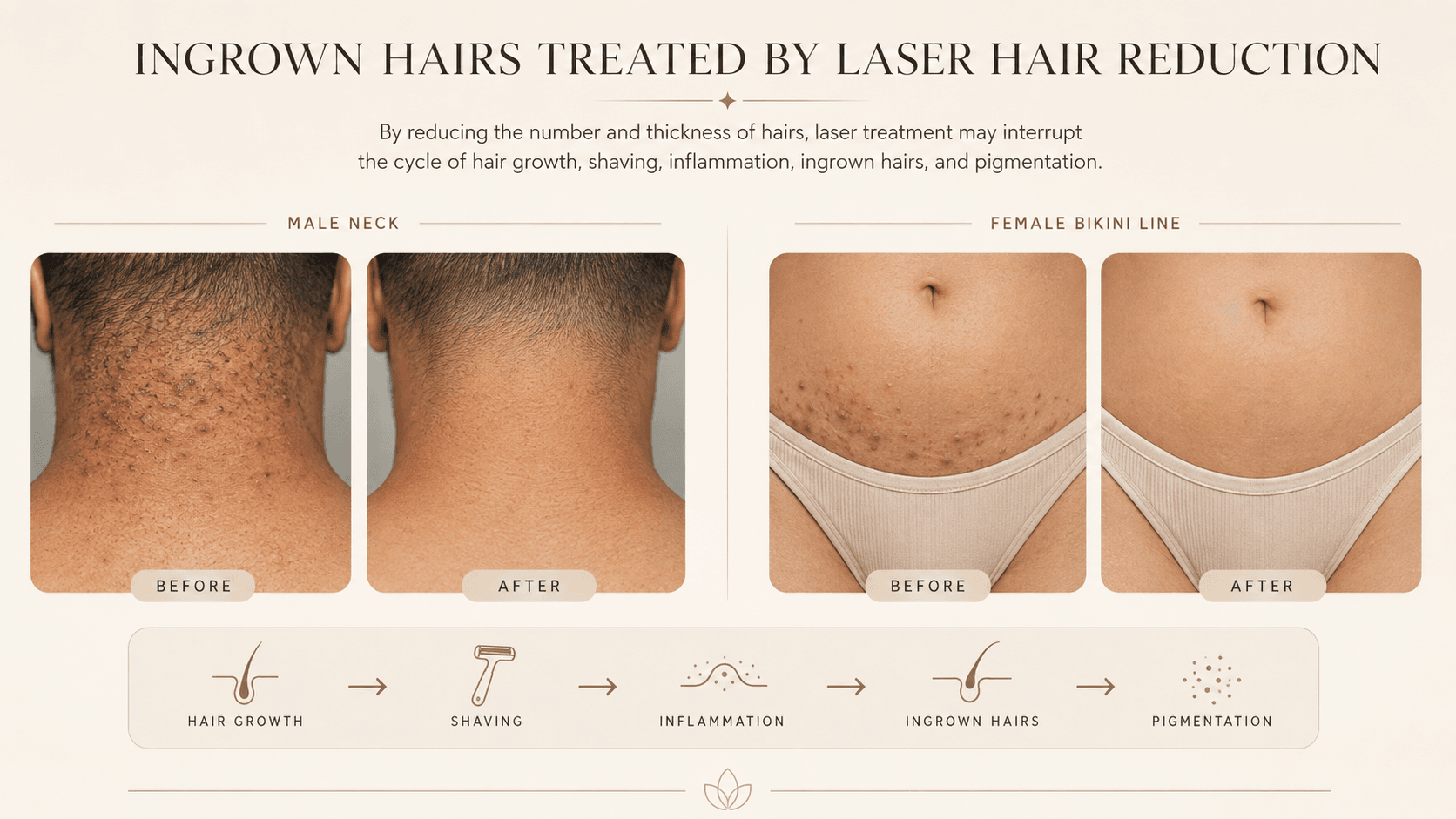
By reducing the number and thickness of hairs, laser treatment may interrupt the cycle of:
Hair growth → shaving → inflammation → ingrown hairs → pigmentation
The 1064 nm Nd:YAG wavelength is particularly useful for pseudofolliculitis barbae in darker skin.
However, active bacterial, fungal or viral infection should be assessed and treated before laser is performed directly over the affected area.
Can Laser Be Performed Over Dark Marks?
It depends on the cause, depth and intensity of the pigmentation.
Post-inflammatory dark marks caused by shaving and ingrown hairs are common.
However, a dark spot may absorb more laser energy than the surrounding skin.
The area may therefore require:
- Altered treatment settings
- A safer wavelength
- Additional cooling
- Temporary avoidance
- Separate pigmentation treatment
- Dermatological assessment
Laser should not be fired directly over an unexplained pigmented lesion simply because it lies within the treatment area.
Moles, changing pigmentation and suspicious lesions require proper clinical assessment.
Can Laser Hair Removal Be Performed Over Tattoos?
No.
Hair-removal laser should not be fired directly over a tattoo.
Tattoo pigment may absorb the laser energy intensely and cause:
- Burns
- Blistering
- Crusting
- Alteration of tattoo colour
- Loss of tattoo detail
- Scarring
The tattoo should be clearly identified, marked and avoided with an appropriate safety margin.
Is Laser Hair Removal Safe During Pregnancy?
Laser hair removal is generally postponed during pregnancy.
This is not because laser hair removal has been proven to harm the baby.
Rather, there is insufficient high-quality evidence confirming the safety of elective cosmetic laser hair removal during pregnancy.
Pregnancy can also change:
- Hormones
- Hair-growth patterns
- Skin sensitivity
- Pigmentation
- The risk of melasma
- The likelihood of post-inflammatory pigmentation
Treatment results may therefore be less predictable.
Laser sessions may usually resume after delivery when the patient’s skin and medical circumstances have been reassessed.
Can I Have Laser Hair Removal While Breastfeeding?
Breastfeeding is not automatically a contraindication to treating distant body areas.
However, treatment should still be discussed with the medical team.
Hormonal changes may influence:
- Hair growth
- Skin sensitivity
- Pigmentation
- Treatment response
Laser should not be performed directly over irritated, infected or inflamed breast skin.
Any topical anaesthetic or medication used during treatment should also be reviewed individually.
Can I Have Laser Hair Removal While Taking Isotretinoin?
Older advice often recommended waiting six months after isotretinoin before undergoing any laser procedure.
More recent evidence suggests that non-ablative procedures, including laser hair removal, may not always require such a prolonged delay.
However, isotretinoin can make the skin:
- Dry
- Fragile
- Sensitive
- Irritated
- More vulnerable to friction
The prescribing dermatologist and laser clinician should therefore assess the patient individually.
Do not stop isotretinoin or any prescription medication without medical advice.
Can Men Have Laser Hair Removal?
Yes.
Male laser hair removal is increasingly requested for:
- Beard shaping
- Neck hair
- Recurrent razor bumps
- Chest hair
- Back hair
- Shoulder hair
- Underarm hair
- Arm hair
- Leg hair
- Full-body hair reduction
- Intimate areas
Male hair is often thicker, denser and more strongly influenced by hormones.
Men may therefore require:
- More treatment sessions
- Stronger but carefully selected settings
- Longer-term maintenance
- Different intervals between sessions
- A personalised reduction rather than complete removal
The treatment goal should be clarified before starting.
Some men want complete reduction, while others want:
- Thinner hair
- Cleaner beard borders
- Less neck irritation
- Less back or shoulder hair
- Better definition
- Reduced density rather than complete removal
Treating the male beard requires careful planning because excessive removal may permanently alter the beard shape.
Can Laser Be Used on Intimate Areas?
Yes.
External bikini and intimate areas can be treated when appropriate:
- Safety protocols
- Privacy protocols
- Hygiene standards
- Skin assessment
- Wavelength selection
- Cooling
- Aftercare
These areas are often naturally darker than the surrounding skin, even in patients with a relatively light complexion.
The 1064 nm Nd:YAG laser may therefore be preferable depending on the patient’s pigmentation and hair characteristics.
Laser should only be applied to appropriate external hair-bearing skin.
Mucosal surfaces and highly sensitive structures must be carefully avoided.
Can I Have Laser During My Period?
Menstruation does not usually prevent laser treatment.
However:
- The skin may feel more sensitive.
- Some patients have a lower pain threshold.
- Hygiene measures are necessary for bikini treatment.
- The patient may feel more uncomfortable.
- The clinic’s treatment policies should be followed.
The treatment can be rescheduled when the patient is uncomfortable.
Why Are My Laser Results Different From Someone Else’s?
Laser hair removal is not a fixed recipe.
Two patients using the same machine may have very different results because of differences in:
- Genetics
- Hormones
- Skin colour
- Hair colour
- Hair diameter
- Hair density
- Follicle depth
- Treatment area
- Hair-growth phase
- Sun exposure
- Session timing
- Previous hair-removal methods
- Laser wavelength
- Treatment settings
- Attendance
- Maintenance needs
Comparing the number of sessions without comparing these factors can be misleading.
Signs That Your Laser Treatment Needs Reassessment
Ask for a clinical review when:
- There has been almost no hair shedding after several sessions.
- The sessions have been timed correctly but there is little improvement.
- The hair is becoming finer but the settings are never reassessed.
- New hair appears around the treatment border.
- Facial hair seems denser.
- Facial hair seems more widespread.
- You repeatedly develop prolonged pigmentation.
- Treatment continues despite recent tanning.
- Every body area is treated with identical settings.
- No one asks about medication.
- No one asks about hormonal symptoms.
- No one asks about sun exposure.
- The operator cannot explain which wavelength is being used.
- Tattoos or dark moles are not being protected.
- Severe pain is dismissed as normal.
Good laser care is not simply completing a prepaid package of sessions.
The response should be reviewed and the treatment plan adjusted as the hair becomes finer and the skin changes.
Dr. Shazia Ali’s Clinical Approach to Laser Hair Removal
Dr. Shazia Ali is a British-trained dermatologist and aesthetic physician with a Master’s degree in Dermatological Sciences from the University of Wales College of Medicine and more than two decades of international clinical experience.
Her approach to dermatological and aesthetic treatment is based on:
- Careful diagnosis
- Evidence-based medicine
- Individualised treatment
- Appropriate technology selection
- Skin-of-colour safety
- Prevention of avoidable complications
- Natural and medically responsible outcomes
For laser hair removal, this means considering:
- The patient’s natural skin phototype
- The skin colour present on the day of treatment
- Recent ultraviolet exposure
- Hair colour
- Hair thickness
- Hair density
- Follicle depth
- The anatomical area
- Previous laser response
- Pigmentation tendency
- Hormonal symptoms
- Medication history
- Medical history
- Risk of paradoxical facial hair growth
- Whether laser is genuinely the correct treatment
At TrueMe Medical Center in Jeddah, access to both the GentleLase Pro Alexandrite laser and GentleYag Pro Nd:YAG laser allows the wavelength to be matched to the individual patient.
Frequently Asked Questions About Laser Hair Removal for Middle Eastern Skin
Which laser is best for Middle Eastern skin?
For lighter, untanned skin with dark hair, the 755 nm Alexandrite laser may provide excellent results.
For olive, brown or deeply pigmented skin, the 1064 nm Nd:YAG laser is usually preferred because it interacts less strongly with surface melanin.
Individual assessment remains essential.
Is Nd:YAG always better for Arab skin?
No.
Middle Eastern patients have a wide range of skin tones.
A fair, untanned Arab patient may be an excellent candidate for Alexandrite treatment.
Nd:YAG is generally safer when the skin is darker, tanned or more prone to pigmentation complications.
Can Alexandrite laser burn olive skin?
Yes, Alexandrite can cause burns or pigmentation when used on unsuitable skin or with inappropriate parameters.
Proper skin assessment, cooling, test treatment and careful setting selection can reduce the risk.
Can dark skin be treated without becoming lighter?
Yes.
Hair-removal laser is intended to target melanin inside the hair follicle, not remove the patient’s natural skin colour.
Temporary darkening or lightening can occur as a complication, but permanent lightening is not an expected or desired treatment result.
Will laser lighten my underarms or bikini area?
Laser hair reduction may indirectly improve darkness caused by:
- Shaving irritation
- Recurrent inflammation
- Ingrown hairs
- Razor bumps
However, laser hair removal is not automatically a pigmentation treatment.
Darkness caused by friction, acanthosis nigricans, hormonal disease or another skin condition may require separate treatment.
Why is my hair still growing after the first session?
Only hairs in the correct active-growth stage respond fully during each treatment session.
Treated hairs may also appear to continue growing for several days before they loosen and shed.
Why did my first sessions work better than later sessions?
The initial coarse, dark hairs contain more melanin and absorb laser energy more effectively.
As the remaining hairs become finer, they become more difficult to target.
The treatment plan may need reassessment rather than continuing identical settings indefinitely.
Can I shave between laser sessions?
Yes.
Shaving is generally the preferred hair-removal method between sessions.
Do not wax, thread, sugar or pluck the hairs unless your treating clinician advises otherwise.
Does shaving make hair grow back thicker?
No.
Shaving cuts the hair at the skin surface and does not increase the number of follicles.
The blunt end of a shaved hair can make early regrowth feel temporarily coarser.
Can laser hair removal cause infertility?
There is no evidence that properly performed laser hair removal causes infertility.
Hair-removal lasers act within the skin and do not penetrate deeply enough to reach the reproductive organs.
Can laser hair removal affect internal organs?
No.
The laser energy used for hair removal is absorbed within the skin and hair follicle.
It does not travel deeply into internal organs.
Can laser hair removal cause cancer?
There is no evidence that standard laser hair removal causes cancer.
Hair-removal lasers use non-ionising light, not ionising radiation such as X-rays.
Can laser permanently damage sweat glands?
Hair-removal lasers are designed to target pigmented hair follicles.
They are not designed to destroy sweat glands, and reduced sweating is not an expected treatment outcome.
Can I exercise after laser hair removal?
It is generally advisable to avoid intense exercise temporarily when heat, friction and sweating could irritate the treated skin.
Follow the specific aftercare instructions provided for your treatment area.
When should I contact the clinic urgently?
Contact the clinic if you develop:
- Significant pain
- Extensive swelling
- Blistering
- Crusting
- Skin breakdown
- Rapidly increasing redness
- Marked darkening
- Marked lightening
- Signs of infection
The Most Important Message
The safest laser hair-removal treatment is not determined by the brand name alone.
It depends on the combination of:
The right patient + the right wavelength + the right settings + appropriate cooling + correct timing + experienced clinical supervision
For Middle Eastern skin, having access to both 755 nm Alexandrite and 1064 nm Nd:YAG technology is particularly valuable.
It allows lighter and darker skin types to be treated according to their biological differences while reducing avoidable complications.
At TrueMe Medical Center in Jeddah, laser hair removal is planned according to the patient’s:
- Skin tone
- Hair characteristics
- Medical history
- Hormonal history
- Sun exposure
- Pigmentation risk
- Treatment area
- Personal goals
The objective is not simply to deliver laser pulses.
The objective is to achieve effective, long-term hair reduction while protecting the health, texture and natural colour of the skin.
Book a Laser Hair Removal Consultation in Jeddah
Patients considering laser hair removal in Jeddah can book an assessment with Dr. Shazia Ali and the TrueMe Medical Center team.
A consultation is particularly important when you have:
- Brown or deeply pigmented skin
- Recent tanning
- PCOS
- Irregular periods
- Facial hair
- Neck hair
- Previous laser burns
- Post-inflammatory hyperpigmentation
- Fine facial hair
- Recurrent ingrown hairs
- Recurrent folliculitis
- A history of unsuccessful laser sessions
- Concerns about which laser machine is being used
A personalised evaluation can determine whether the GentleLase Pro Alexandrite laser, GentleYag Pro Nd:YAG laser, another hair-removal method or no laser treatment is currently the safest option.
This article is intended for general educational purposes and does not replace an individual medical or dermatological consultation.
Clinical References
-
Dorgham NA, et al. Lasers for reduction of unwanted hair in skin of colour: a systematic review and meta-analysis. Journal of the European Academy of Dermatology and Venereology. View the publication
-
Snast I, et al. Paradoxical hypertrichosis associated with laser and light therapy for hair removal: a systematic review and meta-analysis. American Journal of Clinical Dermatology. View the publication on PubMed
-
Alajlan A, et al. Predictors and prevalence of paradoxical hypertrichosis in Alexandrite laser-based facial hair removal. View the publication on PubMed
-
Mysore V, et al. Standard guidelines of care: performing procedures in patients on or recently administered isotretinoin. Journal of Cutaneous and Aesthetic Surgery. View the full article
-
Candela Medical. Gentle Pro Series: 755 nm Alexandrite and 1064 nm Nd:YAG laser technologies. Learn more about the Candela Gentle Pro Series
-
American Academy of Dermatology. Laser Hair Removal: Overview and Preparation. Read the patient guidance