
The Art of Natural Botox Results: Precision Micro-Dosing, Facial Anatomy & Longevity
June 15, 2026
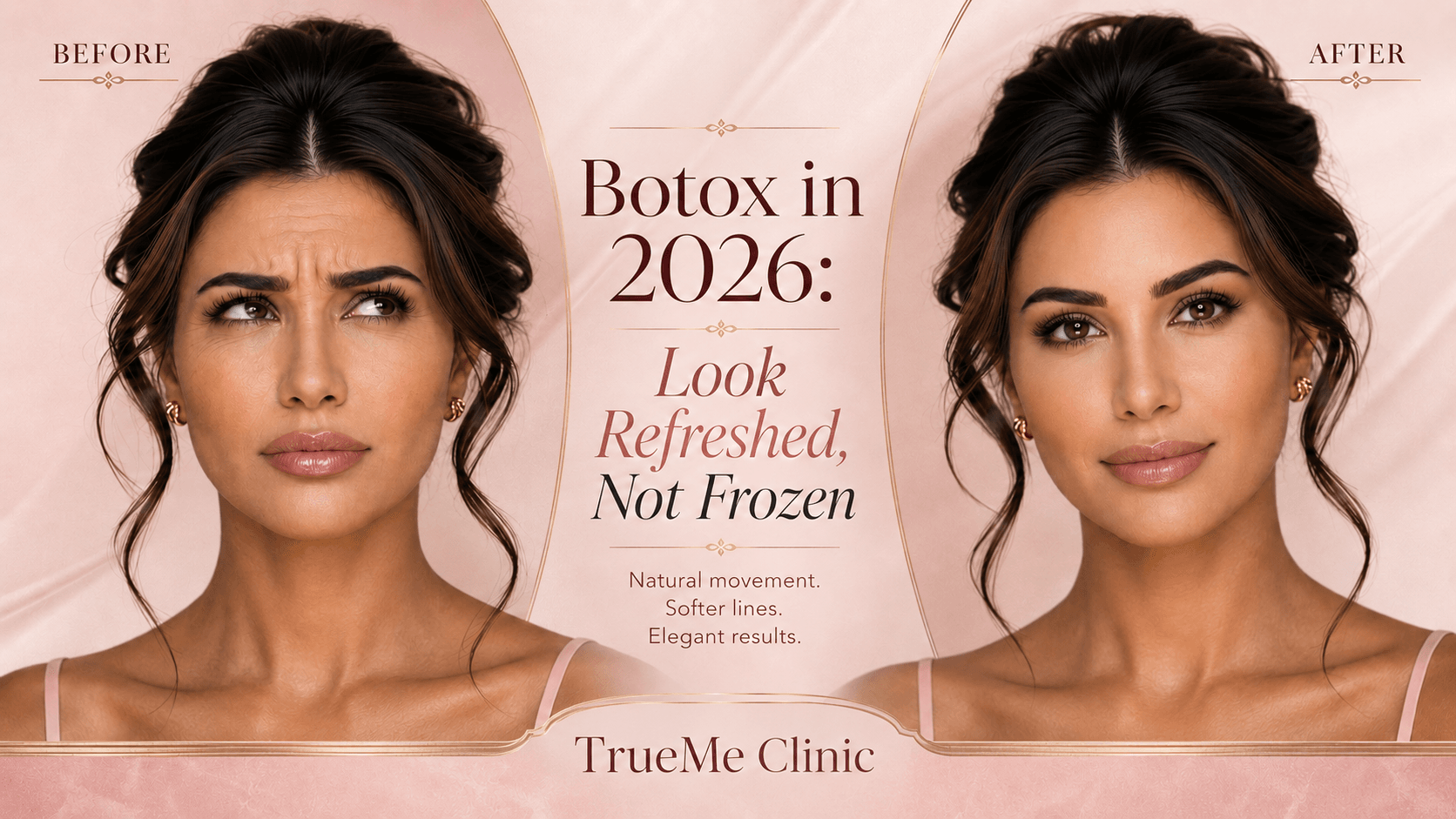
Beyond the Frozen Face: The New Standard of Botox
Modern botulinum toxin treatment should be expression-preserving. The goal of a professional treatment is to soften excessive muscle pull while retaining enough movement for your face to communicate normally.
The aim is not to erase your personality, but to provide a smoother, refreshed appearance.
At TrueMe Medical Center in Jeddah, Dr. Shazia Ali's Botox treatment philosophy is anatomy-respecting and identity-preserving: diagnose the dominant muscles, use a conservative individualized plan, reassess when appropriate, and avoid chasing total immobility.
A first treatment can be deliberately cautious because a little more can be added after review, whereas an excessive dose must be allowed to wear off.
Some of Dr. ShaziaAli's Botulinum Toxin treatment results: Case1: https://drshaziaali.com/en/before-after/499 Case 2: https://drshaziaali.com/en/before-after/498 Case 3: https://drshaziaali.com/en/before-after/497 Combination Treatments - Botulinum Toxin + Filler + Skin Boosting Case 1: https://drshaziaali.com/en/before-after/490 Case2: https://drshaziaali.com/en/before-after/460
When will I see results?
While many people notice early changes within 3–4 days, the effect continues to develop.
A final judgment is typically made at around two weeks post-treatment.
What should I do before and after treatment?
Before treatment
Arrive without pressure to proceed.
Your consultation should cover:
- Diagnosis and facial assessment
- Your treatment goals
- Alternatives
- Informed consent
- Product choice
- Standardized photographs
Mention any important upcoming event so that treatment timing and the possibility of temporary bruising or swelling can be considered.
After treatment
Follow the instructions given for your exact procedure.
In general:
- Avoid rubbing or forcefully massaging the injected areas immediately after treatment.
- Avoid unnecessary pressure on the injection sites while they settle.
- Gentle cleansing and normal facial expression are usually acceptable.
- Ask your treating clinician when to resume strenuous exercise, facials, sauna, makeup and other aesthetic procedures.
Evidence supporting many rigid internet rules—such as never bending over, flying, exercising or lying down after Botox—is limited.
Some traditional aftercare recommendations may be intended primarily to reduce bruising or swelling rather than to alter the effectiveness of the toxin.
For this reason, post-treatment advice should be individualized rather than based on social-media absolutes.
How long do Botox results last?
The duration of your results—commonly around three to four months for glabellar lines—can vary depending on several factors:
- The specific area treated
- The dose of botulinum toxin injected
- Individual muscle strength
- Individual response and metabolism
- Previous treatments
- The degree of movement you wish to preserve
The TrueMe Dr. Shazia Approach: Precision Over Trends
You may have heard marketing terms such as “Baby Botox” or “Micro-Botox.”
At TrueMe Medical Center, we believe precision matters more than the nickname.
A low dose placed poorly is not automatically natural, and a standard dose may be exactly what a strong muscle requires to achieve a balanced, refreshed appearance.
The goal is not simply to use less toxin.
The goal is to use the right dose, in the right muscle, at the right depth and location, for the right patient.
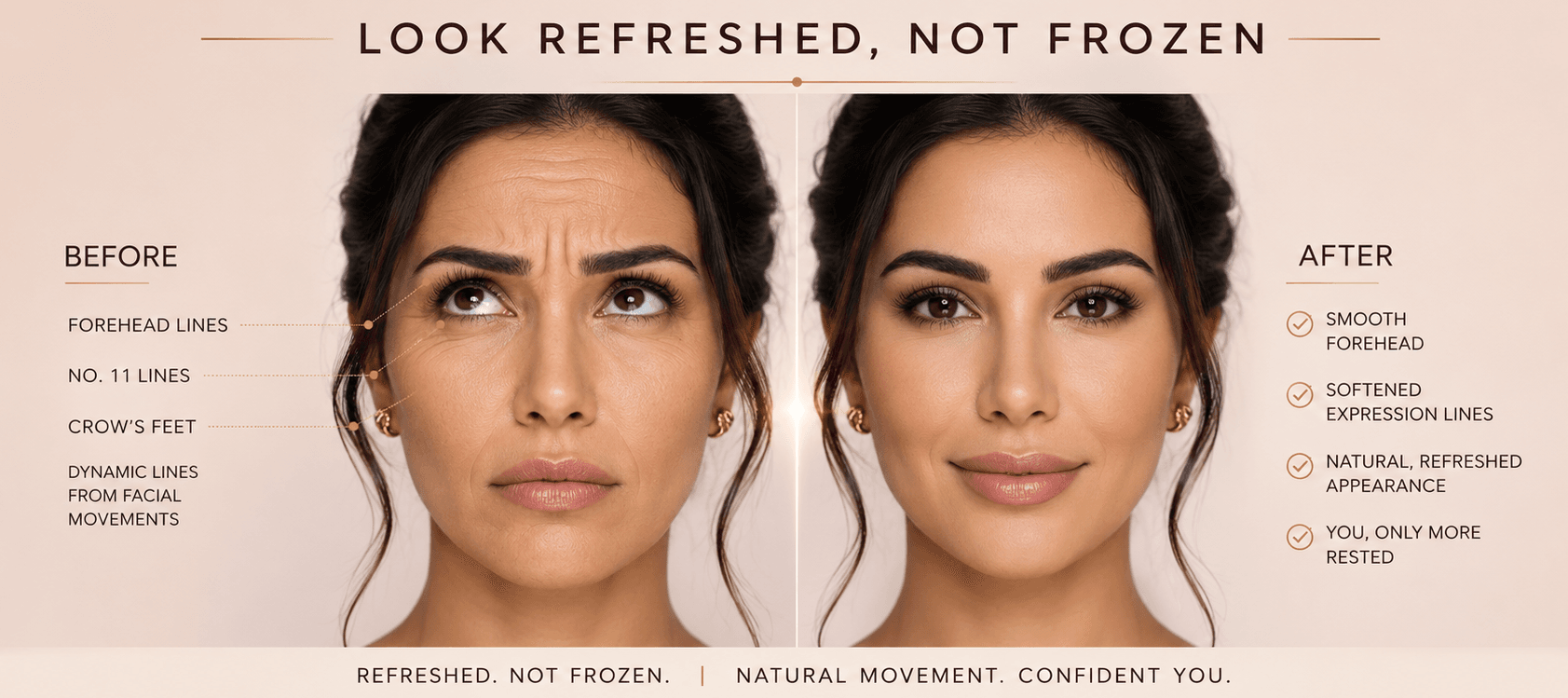
Why does Botox look different from one injector to another?
A face is not a standard injection diagram.
A skilled injector examines your face both at rest and during animation—including frowning, raising the eyebrows and smiling—to understand how your muscles interact before creating a treatment plan.
The result can depend on several important variables:
-
Muscle selection: Treating the wrong balance of brow elevators and depressors can create heaviness, asymmetry or an unnatural brow position.
-
Dose: Too little may produce an incomplete result, while too much may remove movement that is important for expression or brow support.
-
Injection location: Small differences in placement can have a significant effect, particularly around the forehead, brows and eyes.
-
Depth and angle: Injection technique should correspond to the anatomy and depth of the intended target muscle.
-
Dilution and injection volume: These influence how the product is delivered within the tissue and should be considered together with dose, anatomy and treatment objectives.
-
Patient-specific anatomy: Brow height, forehead dimensions, muscle strength, hooded eyelids, facial asymmetry and individual patterns of muscle recruitment all matter.
-
The aesthetic goal: Whether you prefer more movement or a stronger reduction in muscle activity, the treatment strategy should be customized rather than standardized.
This is why copying an injection map from another patient's face does not necessarily produce the same result.
Safety and Quality in Jeddah
Botulinum toxin is a prescription medical treatment, not simply a casual beauty service.
Safety depends on appropriate patient selection, correct diagnosis, anatomical knowledge, appropriate dosing, sterile injection technique and the use of an authentic, registered product obtained through an authorized supply chain.
This is particularly important in Saudi Arabia.
The Saudi Food and Drug Authority (SFDA) has issued safety communications concerning botulinum toxin products and has specifically warned healthcare professionals about falsified products identified in the Kingdom.
In 2025, an SFDA-associated safety communication reported falsified Siax 200 Units (Botulinum Toxin Type A) identified in Saudi Arabia. The counterfeit product demonstrated differences in labeling and packaging and was not associated with the manufacturer's authorized distribution network.
The SFDA has also published product-authenticity guidance emphasizing that healthcare professionals should check identifying packaging features, batch information and the authorized source of the product before use.
Why the supply chain matters
Botulinum toxin is a biological medicine whose quality depends not only on what is inside the vial, but also on how the product has been imported, transported and stored.
SFDA-approved procurement guidance for botulinum toxin products has emphasized:
- Purchasing products through the official authorized distributor or supply channel
- Checking original packaging and product-identification features
- Verifying batch information when authenticity is uncertain
- Maintaining the manufacturer's required cold chain during transportation and storage
- Exercising caution when injectable products are offered at unusually low prices or through unofficial sources
For example, SFDA-approved guidance for NABOTA states that the product requires storage and transportation at 2–8°C and warns that products obtained through unauthorized channels cannot be guaranteed to be genuine.
Improper temperature control may also compromise product quality, effectiveness and potentially safety.
This does not mean that every botulinum toxin product has exactly the same packaging, distributor or storage instructions.
These requirements are product-specific, which is why a medical clinic should obtain each injectable through the officially authorized Saudi supply chain and follow the manufacturer's approved storage requirements.
Botulinum toxin formulations are also not interchangeable unit-for-unit. Different formulations have their own biological potency and dosing characteristics, and units from one product should not automatically be converted to another.
How to choose a safe injector
When looking for Botox treatment in Jeddah, ask questions that reveal clinical judgment and product safety rather than focusing only on price:
- Are you a licensed medical professional trained in facial anatomy and complication management?
- Which botulinum toxin product are you using?
- Is this specific product registered and authorized for use in Saudi Arabia?
- Can I see the original labeled vial or packaging before treatment?
- Is the product obtained through its authorized Saudi distributor or official supply chain?
- Has it been transported and stored according to the manufacturer's required temperature conditions?
- Can the clinic verify the product's batch or authenticity if necessary?
- What muscles are you planning to treat?
- Which muscles or areas are you deliberately leaving untreated?
- How will my existing brow position, eyelid anatomy, muscle strength and facial asymmetry influence the treatment plan?
- What should I expect if I develop an unwanted effect?
A very cheap Botox treatment deserves a question: why?
Price alone does not tell you whether a treatment is good or bad.
However, an injectable offered at a price dramatically below the usual medical-market cost should prompt questions about where the product came from, whether it is authentic and whether correct storage conditions have been maintained.
SFDA product-authenticity guidance has emphasized concerns around products obtained outside official distribution channels, where authenticity, transport conditions and storage may not be assured.
For an injectable biological medicine, authenticity, traceability and cold-chain integrity are part of patient safety.
Regulatory authorities internationally have also repeatedly warned about counterfeit, unapproved or improperly sourced botulinum toxin products.
Never purchase botulinum toxin products online for personal use, obtain them from an unverified source or attempt self-injection.
If you are undergoing treatment in Saudi Arabia, it is reasonable to ask your treating clinic exactly which product is being injected and whether it has been obtained through an authorized Saudi supply channel.
Frequently Asked Questions
Will I look worse when Botox wears off?
No.
Botulinum toxin temporarily reduces neuromuscular activity. As its effect gradually wears off, muscle activity returns over time.
Your face does not suddenly become worse because Botox has disappeared. However, normal ageing and skin changes continue independently of treatment.
Can Botox prevent wrinkles?
Botulinum toxin can reduce repetitive muscular contraction responsible for dynamic expression lines and may therefore help reduce the repeated folding that contributes to these lines becoming more established over time.
However, treatment should be based on your actual facial movement, muscle activity, anatomy and skin quality—not simply on your age.
Not every young person needs preventive Botox.
Can Botox lift my eyebrows?
A subtle chemical brow lift can sometimes be achieved with botulinum toxin by selectively weakening muscles that pull the brow downward.
However, Botox does not physically lift the eyebrow in the way surgery does.
The frontalis muscle is the principal elevator of the brow, while muscles including parts of the orbicularis oculi, corrugator and procerus contribute to downward or medial brow movement.
By carefully reducing selected depressor activity while preserving appropriate frontalis function, the balance of muscular forces may allow a subtle elevation or reshaping of the brow.
The result is highly anatomy-dependent.
If the frontalis is strong and brow depressor activity is significant, the effect may be noticeable.
If the frontalis is weak, or if brow position depends heavily on compensatory frontalis activity, aggressive forehead treatment can instead contribute to brow heaviness.
For this reason, brow treatment should be based on dynamic facial assessment rather than a fixed injection pattern.
References
-
Walker B, Hand M, Chesnut C. Forehead Movement Discrepancies After Botulinum Toxin Injections: A Review of Etiology, Correction, and Prevention. Dermatologic Surgery. 2022;48(1):94–100. doi:10.1097/DSS.0000000000003218. https://pubmed.ncbi.nlm.nih.gov/34537780/
-
de Almeida ART, et al. Understanding the Functional Anatomy of the Frontalis and Glabellar Complex for Optimal Aesthetic Botulinum Toxin Type A Therapy. Aesthetic Plastic Surgery. 2013. https://pubmed.ncbi.nlm.nih.gov/23846022/
-
Cotofana S, et al. Integrative Assessment for Optimizing Aesthetic Outcomes When Treating Glabellar Lines With Botulinum Toxin Type A: An Appreciation of the Role of the Frontalis. Aesthetic Surgery Journal. 2023. doi:10.1093/asj/sjac267. https://pubmed.ncbi.nlm.nih.gov/36322138/
-
Sundaram H, et al. Global Aesthetics Consensus: Botulinum Toxin Type A—Evidence-Based Review, Emerging Concepts, and Consensus Recommendations for Aesthetic Use, Including Updates on Complications. Plastic and Reconstructive Surgery. 2016;137(3):518–529. https://pmc.ncbi.nlm.nih.gov/articles/PMC5242214/
-
Carruthers J, Fagien S, Matarasso SL, Botox Consensus Group. Consensus Recommendations on the Use of Botulinum Toxin Type A in Facial Aesthetics. Plastic and Reconstructive Surgery. 2004;114(6 Suppl):1S–22S. doi:10.1097/01.PRS.0000144795.76040.D3. https://pubmed.ncbi.nlm.nih.gov/15507786/
-
Small R. Botulinum Toxin Injection for Facial Wrinkles. American Family Physician. 2014;90(3):168–175. https://www.aafp.org/pubs/afp/issues/2014/0801/p168.html
-
Goodman GJ, et al. Facial Aesthetic Injections in Clinical Practice: Pretreatment and Posttreatment Consensus Recommendations to Minimise Adverse Outcomes. Australasian Journal of Dermatology. 2020. https://pmc.ncbi.nlm.nih.gov/articles/PMC7497045/
-
Wolf R, Landau M, Davidovici B. Posture Regulations Following Botulinum Toxin Injection: Myth or Reality? Skinmed. 2007;6(3):137–138. doi:10.1111/j.1540-9740.2007.06189.x. https://pubmed.ncbi.nlm.nih.gov/17478993/
-
Allergan Aesthetics / AbbVie. BOTOX Cosmetic (onabotulinumtoxinA) Prescribing Information. https://www.rxabbvie.com/pdf/botox-cosmetic_pi.pdf
-
U.S. Food and Drug Administration. Counterfeit Version of Botox Found in Multiple States. Updated May 1, 2024. https://www.fda.gov/drugs/drug-alerts-and-statements/counterfeit-version-botox-found-multiple-states
-
U.S. Food and Drug Administration. FDA Warns Companies Over Illegal Marketing of Botox and Related Products. November 5, 2025. https://www.fda.gov/news-events/press-announcements/fda-warns-companies-over-illegal-marketing-botox-and-related-products
-
Centers for Disease Control and Prevention. Harmful Reactions Linked to Counterfeit "Botox" or Mishandled Botulinum Toxin Injections. Updated December 17, 2024. https://www.cdc.gov/botulism/outbreaks/harmful-reactions-botox-injections/index.html
-
Saudi Food and Drug Authority. Information for Healthcare Professionals: OnabotulinumtoxinA (marketed as Botox/Botox Cosmetic), AbobotulinumtoxinA and RimabotulinumtoxinB. SFDA. https://www.sfda.gov.sa/en/awarenessarticle/information-healthcare-professionals-onabotulinumtoxina-marketed-botoxbotox
-
Saudi Food and Drug Authority / Daewoong Pharmaceutical Co., Ltd. Verification of Product Authenticity and Procurement Guidance: NABOTA. 2025. https://www.sfda.gov.sa/sites/default/files/2025-10/Nabota.pdf
-
Saudi Food and Drug Authority / Medytox. Falsified Siax 200 Units Identified in Saudi Arabia – Not Associated with Authorized Product. 2025. https://www.sfda.gov.sa/sites/default/files/2025-10/Siax.pdf
This article is intended for general educational purposes and does not replace an individual medical consultation. Botulinum toxin treatment should be performed only after appropriate medical assessment by a qualified healthcare professional.