
Ozempic Face: Restore Volume Without Overfilling
October 1, 2026
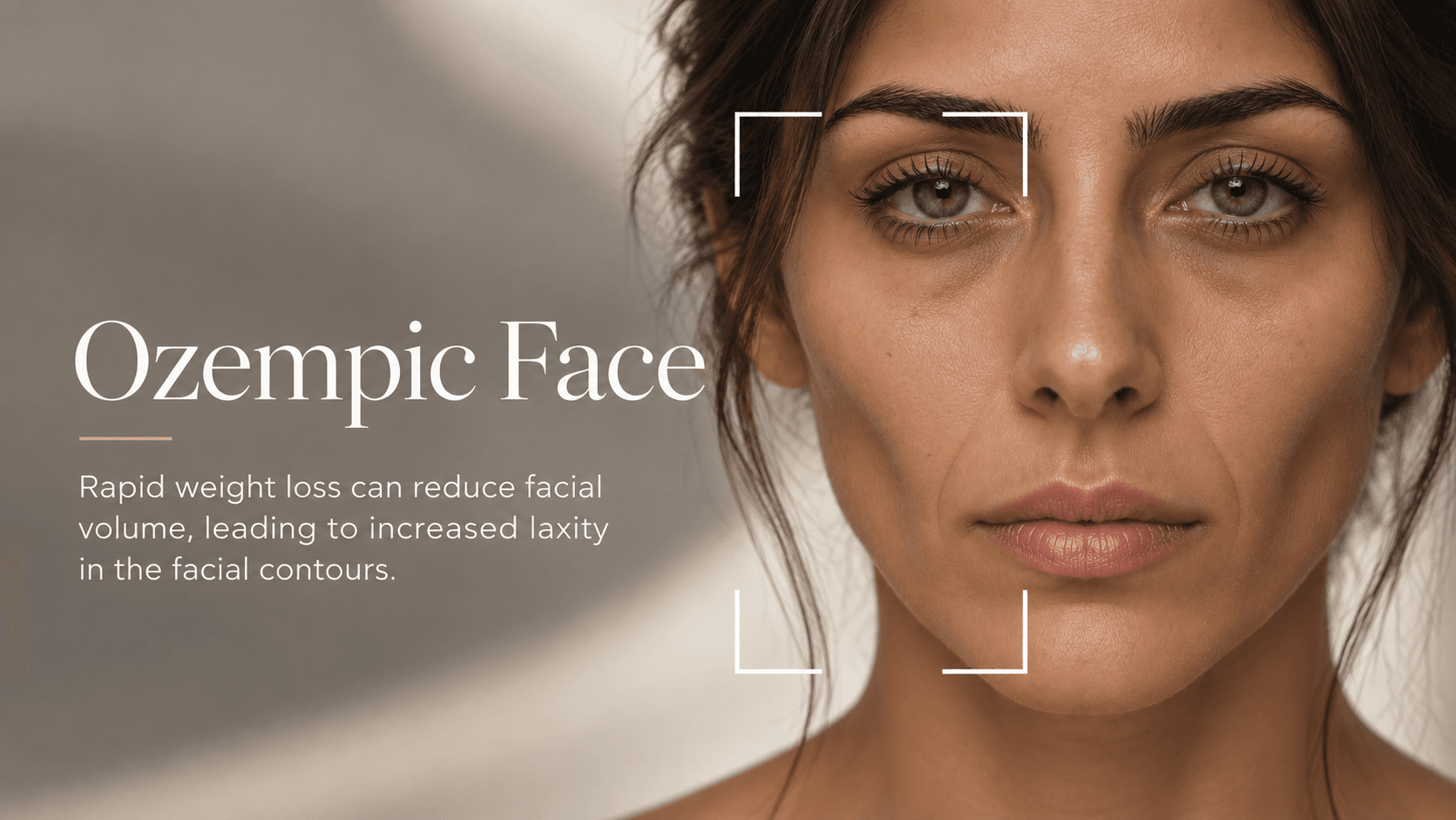
Ozempic Face & Weight-Loss Aging: How to Restore Facial Volume, Skin and Structure Without Looking Overfilled
Losing a significant amount of weight can improve metabolic health and wellbeing, but some patients notice an unexpected change in the mirror: hollow temples, flatter cheeks, deeper folds, under-eye shadowing, looser skin and a face that appears older or more tired. Online, this is often called “Ozempic face.”
The term is misleading. These changes are not unique to Ozempic (semaglutide), and current evidence does not establish “Ozempic face” as a specific disease or simply a toxic effect of the medication. Similar facial deflation can follow substantial weight loss from GLP-1-based treatment, bariatric surgery, dieting or other causes.
For patients experiencing facial aging after weight loss in Jeddah and Saudi Arabia, the key is not to refill every hollow. Natural restoration requires understanding what has changed in the fat compartments, structural support, skin and collagen, then treating each layer selectively.
The goal should be to restore proportion, support and skin quality without creating an overfilled face.
What Is “Ozempic Face”?
“Ozempic face” is a popular, non-medical term describing facial changes that may become noticeable after substantial weight loss, particularly in people using GLP-1-based medications.
Typical changes include:
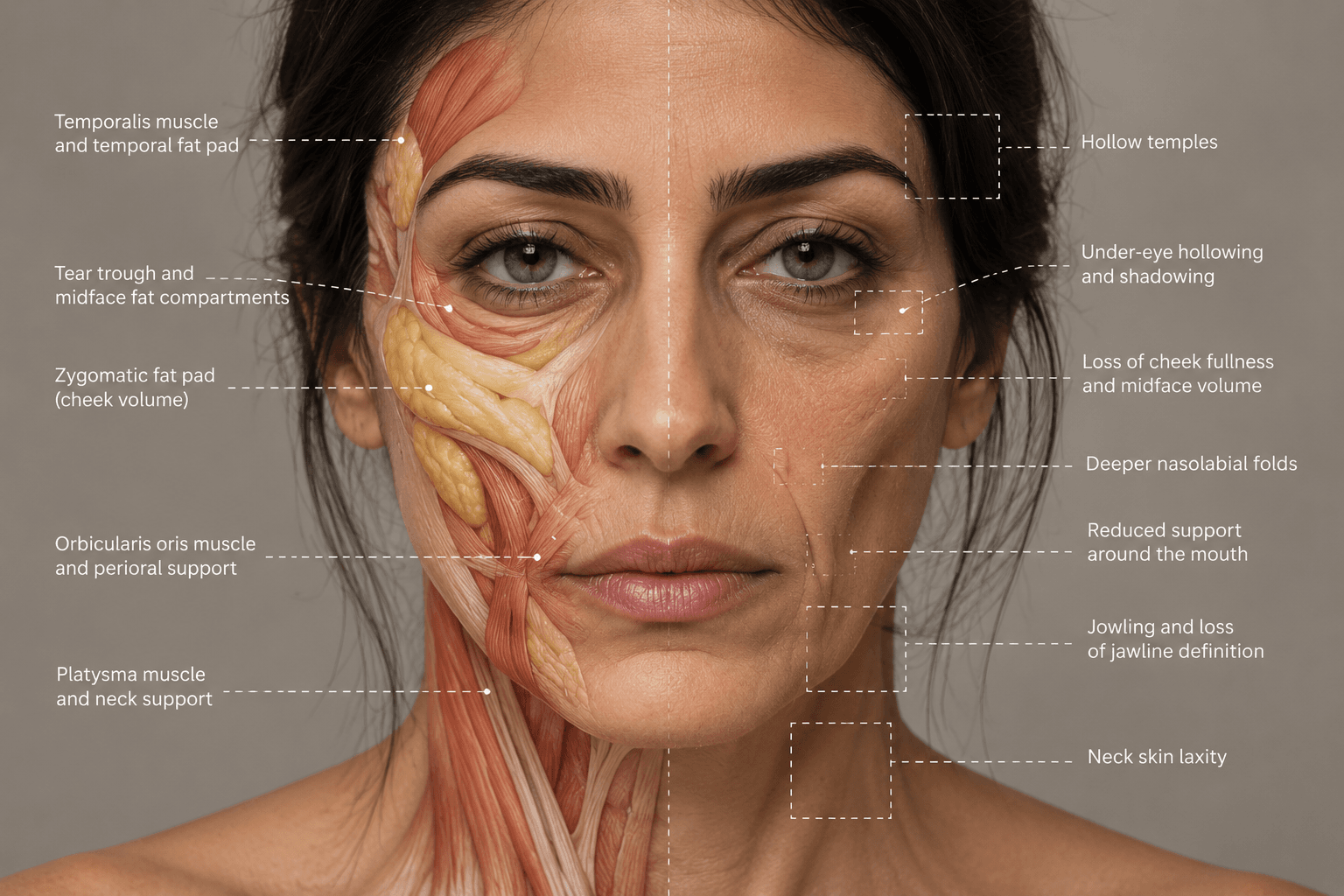
- Hollowing of the temples
- Loss of cheek fullness
- Increased visibility of the cheekbones
- Under-eye hollowing or shadowing
- Deeper nasolabial folds
- More visible marionette lines
- Reduced support around the mouth
- Jowling
- Loose facial or neck skin
- Fine wrinkles and crepiness
- A more tired, gaunt or aged appearance
The phenomenon should more accurately be considered weight-loss-associated facial deflation and laxity.
Ozempic is a brand of semaglutide, but facial deflation is not exclusive to semaglutide. It can occur after significant weight loss associated with other treatments, including tirzepatide, or after weight loss without medication.
Does Ozempic Actually Age Your Face?
The strongest evidence suggests that much of the visible change comes from substantial loss of facial fat and the way the skin and supporting tissues respond to that loss. It has not been established that semaglutide directly “ages” the face in the way the term “Ozempic face” sometimes implies.
This distinction matters.
In the STEP 1 trial, adults receiving semaglutide 2.4 mg achieved a mean body-weight reduction of approximately 14.9% at 68 weeks, compared with 2.4% with placebo.
Tirzepatide can produce even greater average weight reductions at higher doses in some populations. In the SURMOUNT-1 trial, mean weight reductions at 72 weeks were approximately 15.0%, 19.5% and 20.9% with 5 mg, 10 mg and 15 mg doses respectively.
When somebody loses 15–20% or more of total body weight, it is unsurprising that some of that change becomes visible in the face.
There is emerging scientific discussion about whether GLP-1 receptor signalling may also influence adipocytes, fibroblasts or other aspects of skin biology. These hypotheses are interesting but remain substantially less established than the simple relationship between major weight loss, facial fat reduction and tissue deflation.
We should therefore avoid presenting an evolving biological hypothesis as settled fact.
Why Does the Face Sometimes Look Older After Major Weight Loss?
Facial youthfulness depends partly on the relationship between the skin and the volume and structural support underneath it. Significant fat loss can change that relationship rapidly.
A younger face is not simply a face with more fat. It is a highly organized three-dimensional structure involving:
- Bone
- Deep facial fat
- Superficial fat compartments
- Retaining ligaments
- Fascia
- Muscle
- Dermis
- Collagen and elastin
- Skin surface
Natural aging already affects all of these layers.
Weight loss can superimpose additional soft-tissue deflation onto those existing age-related changes.
Facial Fat Does Not Behave as One Single Layer
The face contains multiple separate fat compartments.
Some provide contour. Others support the transition between the lower eyelid and cheek, temples, midface, mouth and jawline.
Research following adults over more than a decade has demonstrated measurable loss from both superficial and deep midfacial fat compartments with normal aging.
If substantial weight loss is added to this process, a patient who previously appeared youthful may suddenly notice anatomy that had been partially concealed by facial fullness.
This is why some patients say:
“I am healthier and slimmer, but my face suddenly looks older.”
The weight loss has not necessarily created every component of aging. It may have unmasked and amplified changes that were already developing.
Which Parts of the Face Are Most Affected?
The pattern varies considerably between individuals.
Temples
Temporal fat loss can create concavity between the forehead and cheekbone. Severe hollowing may make the lateral orbital rim and zygomatic arch more apparent.
Under-Eye Area
Loss of surrounding support can make the tear trough or lid-cheek junction more visible. Importantly, this does not automatically mean that tear-trough filler is required.
The apparent under-eye hollow may partly result from changes elsewhere in the mid-face.
Mid-face and Cheeks
Cheek deflation may reduce the smooth convexity associated with a youthful mid-face. The face may become narrower, flatter or more angular.
Nasolabial Area
Reduced mid-facial support may make the nasolabial fold appear deeper. Simply filling the fold itself is not always the most anatomical solution.
Lower Face
Volume redistribution, deflation and skin laxity may make:
- Marionette lines
- Pre-jowl hollows
- Jowls
- Chin irregularities
- Jawline laxity
more apparent.
Neck
If substantial weight has been lost, redundant skin may become particularly noticeable beneath the chin and across the neck. This is important because severe skin excess cannot be corrected simply by adding facial filler.
Who Is Most Likely to Develop Noticeable Weight-Loss Facial Aging?
There is no precise threshold at which “Ozempic face” occurs. Visible changes are more likely to be significant when several factors coexist:
- Larger total weight loss
- Faster weight loss
- Lower final body-fat percentage
- Older age
- Pre-existing facial volume loss
- Thin facial anatomy
- Reduced skin elasticity
- Significant photodamage
- Smoking history
- Menopause and age-related tissue change
- Previous aggressive facial fat removal
- Previous overuse or poorly positioned filler
- Substantial pre-existing skin laxity
Two people losing exactly the same number of kilograms can therefore have completely different facial outcomes.
Should You Stop Ozempic, Wegovy or Mounjaro Because Your Face Looks Older?
Do not stop or alter a medically prescribed weight-loss or diabetes medication solely because of an aesthetic facial concern without discussing it with the clinician managing your treatment.
These medications may have important metabolic and medical benefits. The aesthetic issue and the medical indication should be considered separately.
In Saudi Arabia, GLP-1-based and related weight-management medications should be obtained through legitimate medical and pharmacy channels and used under appropriate clinical supervision. The Saudi Ministry of Health has specifically warned against unregistered weight-loss medicines and products supplied through unauthorized sources.
A dermatologist can address facial changes, but decisions regarding obesity or diabetes medication belong within the appropriate medical management plan.
Should I Wait Until My Weight Is Stable Before Treating My Face?
For substantial structural correction, it is often sensible to understand where the patient's weight is heading before attempting complete facial restoration. However, there is no universal rule requiring every aesthetic treatment to wait until a particular number of months has passed.
If somebody is still losing weight rapidly, restoring the face aggressively can become a moving target. Additional facial volume may disappear, skin laxity may evolve and proportions may continue changing.
A more conservative approach during active weight loss may focus on:
- Skin health
- Photo-protection
- Maintaining the skin barrier
- Selected collagen-remodelling strategies
- Conservative treatment of clearly defined structural deficits
- Monitoring the evolving facial anatomy
Once the weight trajectory is more stable, the final degree of volume loss and laxity becomes easier to assess.
How Should “Ozempic Face” Be Assessed?
The consultation should diagnose the layer that has changed rather than simply count how many syringes might be required. I assess the face as a three-dimensional structure.
1. Structural Support
Has loss of soft-tissue coverage exposed underlying skeletal anatomy?
Does the cheek, chin or jawline actually require support?
2. Deep and Superficial Volume
Where has genuine deflation occurred?
The temples, lateral cheek and mid-face may require very different treatment strategies.
3. Skin Quality
Is the skin:
- Thin?
- Crepey?
- Dry?
- Photodamaged?
- Pigmented?
- Elastotic?
- Wrinkled?
- Lax?
These are not interchangeable diagnoses.
4. Tissue Descent
Is there mild laxity that may respond to collagen remodelling, or significant redundant skin that is unlikely to respond sufficiently to non-surgical treatment?
5. Facial Proportion
How did the face look before weight loss? The objective should not necessarily be to recreate the patient's highest-weight face. Sometimes weight loss reveals attractive skeletal definition that should be preserved.
6. Previous Treatments
Previous HA filler, bio-stimulators, threads, energy devices or surgery can substantially alter the treatment plan.
Understanding the difference between fillers, skin boosters and collagen biostimulators is particularly important because these treatments address different anatomical and tissue-quality problems.
How Do You Restore the Face Without Making It Look Overfilled?
The safest aesthetic principle is not to replace every lost volume unit with an injectable. Restore what needs structural support, stimulate what needs tissue improvement, tighten what is lax and leave naturally attractive contours alone.
A useful treatment framework is:
| Main Problem | Treatment Category That May Be Considered | Primary Objective |
|---|---|---|
| True localized volume loss | HA filler | Precise volume replacement/support |
| Diffuse facial deflation | Conservative HA and/or selected biostimulation | Global restoration without excessive projection |
| Reduced dermal firmness | CaHA or PLLA in selected patients | Collagen remodelling |
| Dehydrated/crepey skin | HA skin-quality treatment | Hydration and selected skin-quality improvement |
| Mild-to-moderate laxity | Microfocused ultrasound/RF-based treatment | Tissue tightening/remodelling |
| Texture and fine lines | RF microneedling/fractional resurfacing/other selected modalities | Dermal remodelling |
| Significant redundant skin | Surgical consultation | Mechanical removal/repositioning of excess tissue |
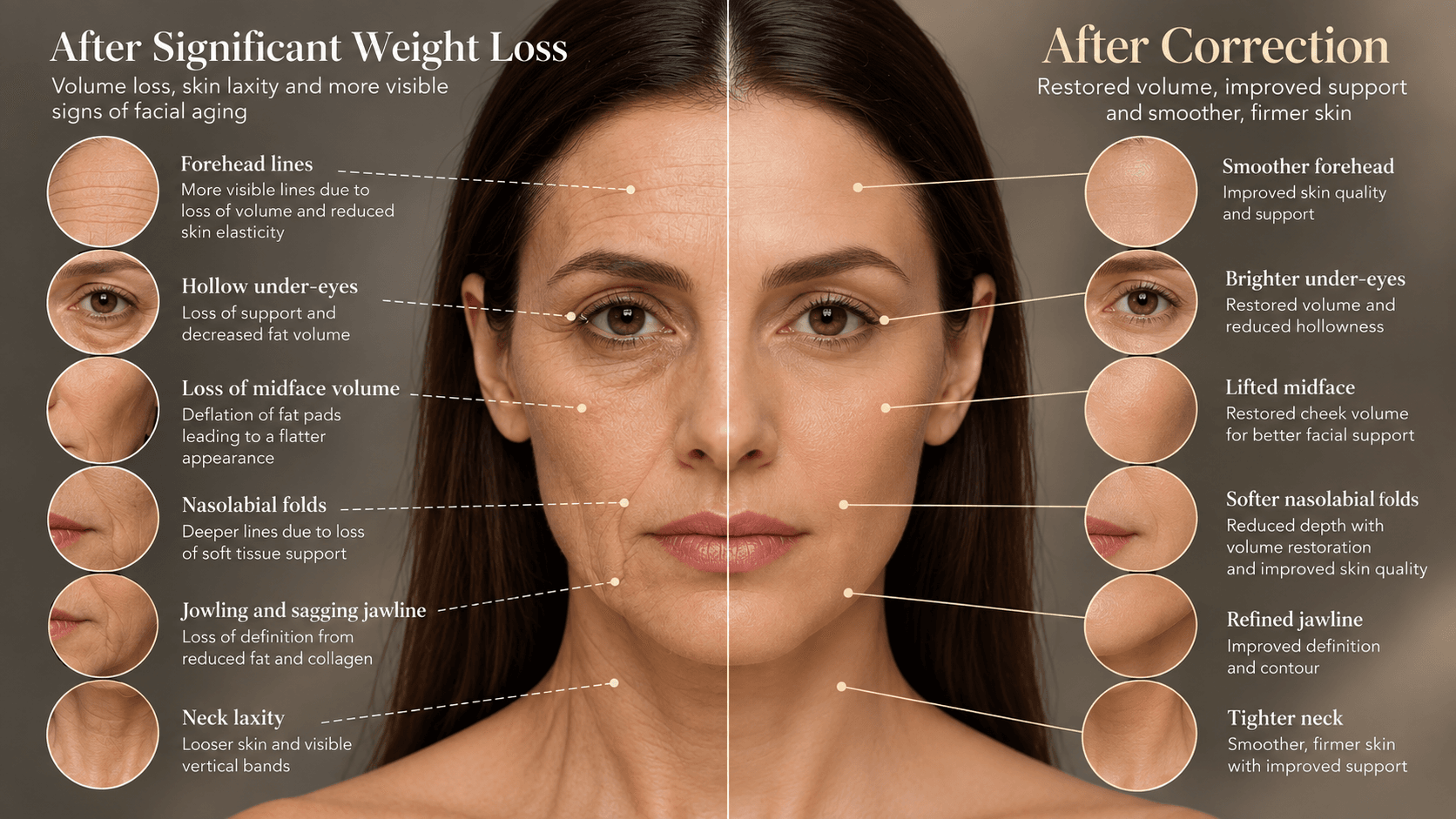
The most natural results often come from combining small interventions that perform different jobs, rather than trying to make filler perform all of them.
Hyaluronic Acid Filler: When Does It Help?
HA filler remains one of the most precise tools for restoring true localized volume loss after weight reduction. The key is strategic placement rather than indiscriminate filling.
Depending on anatomy, conservative HA restoration may be considered in areas such as:
- Temples
- Lateral cheek
- Selected deep midface compartments
- Chin
- Pre-jowl region
- Jawline
- Carefully selected perioral areas
Different HA gels have different rheological characteristics. A product selected for deep structural support should not automatically be used for every superficial or mobile area.
The principle I prefer is:
Right product. Right plane. Right amount.
The objective is not to make the face larger.
It is to restore specific anatomical transitions that have become depleted. This is also why facial filler does not have to create an overfilled appearance when product selection, anatomical placement and volume are carefully controlled.
Why Can Too Much Filler Make Weight-Loss Aging Look Worse?
An overfilled face can occur when volume is used to treat problems that are not actually caused by insufficient volume.
For example:
- Loose skin is treated with repeated filler.
- Every nasolabial fold is filled directly.
- Under-eye shadowing is treated without assessing the cheek.
- The midface is repeatedly enlarged in an attempt to “lift” significant jowls.
- Biostimulators and HA are repeatedly layered without reassessing total facial volume.
This can gradually change:
- Facial width
- Cheek projection
- Eye shape
- Smile dynamics
- Lower-face heaviness
- Natural anatomical transitions
A patient who has become slimmer may then paradoxically acquire a face that looks heavier and more injected than the rest of the body.
Should Every Hollow Be Filled?
No. A hollow is not automatically a defect.
After weight loss, stronger cheekbone definition or a slightly leaner facial contour may actually be attractive.
The question is whether a hollow produces:
- Disproportion
- Excessive skeletalization
- Tiredness
- Unnatural shadowing
- Loss of structural continuity
rather than whether a depression exists at all.
This distinction is one of the most important safeguards against overfilling and is central to advanced injectables and facial contouring in Jeddah.
What Role Do Collagen Biostimulators Play?
Biostimulators may be particularly useful when the problem is broader tissue thinning or reduced collagen support rather than one sharply defined missing volume compartment.
Two established categories are calcium hydroxylapatite (CaHA) and poly-L-lactic acid (PLLA).
They should not be regarded as interchangeable, and neither is incapable of changing facial volume.
Calcium Hydroxylapatite — CaHA
CaHA has both physical and biostimulatory properties.
Depending on formulation, dilution and technique, it may be used more toward:
- Structural contouring
- Dermal support
- Skin firmness
- Collagen and extracellular-matrix remodelling
Diluted or hyperdiluted approaches are often used when the objective is tissue-quality improvement rather than significant projection.
Poly-L-Lactic Acid — PLLA
PLLA stimulates a gradual tissue response resulting in collagen formation.
It may be useful for selected patients with broader facial deflation who want progressive rather than immediate restoration.
The effect develops over months.
Systematic reviews support its ability to improve facial lipoatrophy and tissue quality, although the quality of evidence across studies is variable.
These approaches form part of the broader field of regenerative aesthetics and skin rejuvenation, where treatment is directed not only toward replacing volume but also toward improving tissue quality.
Can Biostimulators Cause an Overfilled Appearance?
Yes, potentially.
“Collagen stimulation” does not mean “zero volume.”
Repeated treatment can progressively increase tissue thickness and fullness.
The same restraint required with HA should therefore be applied to biostimulators.
Can Skin Boosters Restore an Ozempic Face?
Skin boosters may improve hydration and selected skin-quality parameters, but they cannot replace major facial volume or mechanically correct significant skin laxity.
This distinction prevents unrealistic expectations.
A skin-quality injectable may be useful when weight loss has left the skin appearing:
- Crepey
- Dehydrated
- Fine-lined
- Less elastic
- Less luminous
But it should not be expected to reconstruct a depleted temple or restore a significant cheek-volume deficit.
Skin quality and facial volume are different problems.
Can Microfocused Ultrasound Tighten Loose Skin After Weight Loss?
Microfocused ultrasound can improve mild-to-moderate facial and submental laxity in appropriately selected patients, but it cannot reproduce a surgical facelift in significant redundant skin.
Systematic reviews and meta-analyses support measurable improvement in facial tightening in selected patients.
Patient selection is critical after major weight loss.
A very thin, volume-depleted face should not automatically receive aggressive energy treatment simply because laxity is present. The clinician must consider:
- Remaining subcutaneous tissue
- Treatment depth
- Energy delivery
- Facial anatomy
- Degree of laxity
- Whether volume restoration should precede or follow tightening
More treatment is not necessarily better treatment. Careful patient selection and appropriate technology are fundamental when considering advanced energy-based treatments in Jeddah.
What About Radiofrequency Microneedling?
RF microneedling can improve skin texture and tightening through controlled dermal radiofrequency injury and collagen remodelling.
A 2026 systematic review found generally favorable improvements in facial rejuvenation outcomes, with erythema and edema among the common temporary effects.
RF and RF microneedling have also been studied in darker skin phototypes and may offer advantages because their effect is not dependent on epidermal melanin in the same way as many light-based technologies.
For patients interested in the technology in greater detail, I discuss RF microneedling and collagen remodelling in Jeddah, including its role alongside other collagen-remodelling treatments.
However, RF microneedling is not risk-free.
Potential complications include:
- Prolonged erythema
- Swelling
- Pigmentary change
- Burns
- Track marks
- Scarring
- Unwanted fat injury when inappropriate parameters or depths are used
This last issue is especially relevant in a face that is already volume depleted.
Can Lasers Improve Weight-Loss Facial Aging?
Lasers can improve selected surface manifestations of aging, including:
- Photodamage
- Fine lines
- Texture
- Dyschromia
- Selected wrinkles
But laser treatment does not replace deep facial fat.
A patient with both photodamage and major facial deflation may therefore need completely different treatments for each problem.
Why Does Skin Type Matter in Jeddah and Saudi Arabia?
Many patients I see in Jeddah have Fitzpatrick skin phototypes III–V, and post-inflammatory hyperpigmentation must be considered when planning procedures that create inflammation.
This is particularly important with:
- Fractional resurfacing
- Aggressive microneedling
- RF microneedling
- Chemical peels
- Some laser treatments
Jeddah's intense sun exposure also makes rigorous photoprotection important during treatment courses.
UV exposure contributes independently to collagen degradation, pigmentation and visible skin aging. Treating facial volume while ignoring chronic photodamage addresses only part of the problem.
For pigmentation-prone Middle Eastern skin, the treatment plan should therefore protect both facial architecture and skin colour stability.
What About Protein, Nutrition and Exercise?
Aesthetic treatment should not distract from the fundamentals of healthy weight management.
Patients undergoing major weight loss should discuss adequate:
- Protein intake
- Micronutrient intake
- Resistance exercise
- Hydration
- Overall nutritional quality
with the healthcare professionals supervising their weight-management program.
This is particularly relevant when appetite suppression becomes substantial.
No supplement, collagen powder or skincare product can reliably replace a depleted deep facial fat compartment. Equally, aesthetic injections should not substitute for adequate nutrition.
When Is Surgery More Appropriate Than Injectables?
When substantial weight loss leaves significant redundant facial and neck skin, surgery may provide a more anatomically appropriate correction than repeatedly adding volume.
This is a critical point.
After major weight loss, some patients develop a combination of:
- Severe lower-face laxity
- Jowling
- Neck skin redundancy
- Platysmal changes
- Soft-tissue deflation
Trying to camouflage severe tissue descent with increasingly large amounts of filler can create heaviness without solving the mechanical problem.
In appropriately selected patients, a facial plastic or plastic surgical assessment may be more logical.
Recognizing when not to inject is part of good aesthetic medicine.
What Is the Best Treatment Sequence?
There is no universal protocol, but a staged approach often makes sense.
Stage 1: Understand the Weight Trajectory
Determine whether weight is still falling rapidly or has become relatively stable.
Stage 2: Assess the Entire Face
Separate:
- Volume loss
- Structural deficiency
- Skin laxity
- Skin quality
- Dynamic wrinkles
- Pigmentation
- Surface photodamage
Dynamic facial aging should also be assessed independently rather than automatically treated with more volume. The objective with neuromodulator treatment is maintaining natural facial movement during rejuvenation, rather than creating a frozen or expressionless appearance.
Stage 3: Decide Whether Significant Laxity Requires Surgery
This prevents attempts to camouflage surgical anatomy with excessive filler.
Stage 4: Restore Only Important Structural Deficits
Use conservative amounts of appropriately selected HA or other structural treatment where true anatomical support has been lost.
Stage 5: Address Tissue Quality
Depending on the patient, this may include:
- CaHA
- PLLA
- Skin-quality HA
- RF microneedling
- Microfocused ultrasound
- Fractional resurfacing
- Other evidence-based dermatological treatments
Stage 6: Reassess Before Adding More
This is one of the most important steps.
A treatment plan should evolve according to the patient's response rather than according to a predetermined number of syringes.
How Many Sessions Are Usually Needed?
There is no meaningful single number because each treatment works differently.
Typical patterns may include:
| Treatment | General Treatment Pattern |
|---|---|
| HA structural restoration | Often staged; visible immediately, then reassessed after swelling settles |
| CaHA | Often 1–3 staged treatments depending on indication and technique |
| PLLA | Commonly performed as a series with progressive reassessment |
| HA skin-quality treatments | Usually a treatment course followed by maintenance depending on product |
| RF microneedling | Often several sessions |
| Microfocused ultrasound | Frequently performed as a single treatment followed by later assessment |
| Fractional resurfacing | Number depends heavily on device, indication, skin type and treatment intensity |
These are general clinical patterns rather than prescriptions.
When Will I See Results?
The timeline depends on the mechanism.
HA filler: Structural change is visible immediately, although swelling means the early result is not the final result.
CaHA: Some formulations may create an immediate effect, with tissue remodelling developing progressively.
PLLA: Improvement develops gradually over months as collagen response evolves.
Skin boosters: Hydration and skin-quality changes develop over the following weeks and may require a treatment series.
Microfocused ultrasound and RF-based treatments: Collagen remodelling develops gradually over several months.
This is another reason not to layer treatments too quickly.
The face needs time to declare the result.
How Long Do Results Last?
Duration depends on:
- Product
- Anatomical area
- Injection depth
- Treatment dose
- Tissue quality
- Age
- Metabolism
- Ongoing weight change
- Skin health
- Lifestyle
- Previous procedures
Weight-loss-associated aging is particularly dynamic.
If substantial weight loss continues after treatment, the facial anatomy may continue to change even while the injected product remains present.
What Are the Risks?
Every medical aesthetic procedure carries risk.
HA Filler Risks
These include:
- Swelling
- Bruising
- Tenderness
- Asymmetry
- Nodules
- Contour irregularity
- Infection
- Delayed inflammatory reactions
- Vascular occlusion
Vascular occlusion is uncommon but potentially serious and can cause tissue injury; in rare circumstances vascular filler complications can threaten vision.
Biostimulator Risks
Depending on the material, risks can include:
- Swelling
- Bruising
- Tenderness
- Papules
- Nodules
- Inflammatory reactions
- Infection
- Irregularity
- Vascular complications
Unlike HA, CaHA and PLLA cannot simply be dissolved with hyaluronidase.
Energy-Device Risks
These may include:
- Pain
- Redness
- Swelling
- Burns
- Pigmentation
- Scarring
- Altered sensation
- Unwanted tissue injury
The risk profile depends strongly on device, settings, treatment depth, anatomy, skin type and operator experience.
How Much Does Ozempic-Face Treatment Cost in Jeddah?
There is no meaningful single price because “Ozempic face treatment” is not one procedure.
One patient may require only conservative temple or cheek restoration.
Another may require a staged combination of structural HA, collagen biostimulation and skin tightening.
A third may require no filler at all and may be better served by surgical assessment.
For that reason, comparing clinics solely by the price of a syringe or package can be misleading.
A more useful question is:
What anatomical problem is being treated, how much treatment is genuinely necessary, and what is the expected endpoint?
What I Tell My Patients in Jeddah
When a patient comes to me after significant weight loss, I do not try to rebuild the face they had at their previous weight.
Weight loss can reveal beautiful definition.
The aim is to identify which changes look healthy and elegant, and which represent excessive deflation, loss of support or declining tissue quality.
I prefer to restore selectively.
A temple may need support.
A lateral cheek may need a small amount of volume.
The skin may need collagen stimulation rather than another syringe of HA.
Mild laxity may benefit from an energy-based treatment.
Significant redundant skin may require a surgical conversation.
And sometimes an area that looks hollow should simply be left alone.
My guiding principle remains:
the right product, in the right tissue plane, in the right amount, for the right anatomical reason.
The goal after weight loss should not be to replace every millilitre that disappeared.
It should be to preserve the healthier, slimmer face while restoring support, tissue quality and facial harmony without erasing identity.
Frequently Asked Questions
Is Ozempic face permanent?
Not necessarily. Some facial changes may become less striking once weight stabilizes and the tissues have had time to adapt, but significant loss of facial fat or redundant skin should not be assumed to spontaneously return completely.
Does everyone who takes Ozempic develop facial aging?
No. Facial changes vary according to the amount and rate of weight loss, age, genetics, baseline facial anatomy, skin elasticity and other factors.
Is Ozempic destroying collagen in my face?
This has not been established. Emerging research is exploring possible GLP-1-related effects on skin and adipose biology, but the better-established explanation for most visible changes remains substantial weight loss and loss of facial soft-tissue volume.
Is “Mounjaro face” different from “Ozempic face”?
There is no established separate facial disorder called Mounjaro face. Similar facial deflation may occur whenever substantial weight loss occurs, including during treatment with semaglutide or tirzepatide.
Will my face improve if I regain weight?
Some facial volume may return with weight regain, but the pattern is unpredictable. Regaining weight purely to alter facial appearance is not an appropriate aesthetic strategy when weight loss has been medically beneficial.
Should I wait until I finish losing weight before having filler?
Major restoration is often easier to plan once the weight trajectory is relatively stable, but treatment timing should be individualized. Conservative treatment may sometimes be reasonable during ongoing weight loss.
What is the best filler for Ozempic face?
There is no single “Ozempic face filler.” Product choice depends on the anatomical region, required projection, tissue mobility, depth, skin quality and desired degree of structural support.
Can filler fix loose skin after weight loss?
Filler can restore selected volume deficits but cannot remove significant excess skin. Using increasing amounts of filler to disguise major laxity can produce an unnatural, heavy appearance.
Is Sculptra better than filler after weight loss?
Neither is universally better. PLLA is useful when gradual collagen-mediated restoration is appropriate, while HA allows more precise and immediate correction of specific structural deficits.
Is Radiesse useful for Ozempic face?
CaHA can be useful in selected patients for structural support or collagen biostimulation depending on how it is formulated and used. It is not appropriate for every facial region or every patient.
Can I combine filler and a biostimulator?
Yes, when they are treating different diagnosed problems. Structural HA may correct a specific deficit while a biostimulator addresses broader tissue quality. Combination treatment should not simply mean adding more product.
Can skin boosters replace lost facial fat?
No. Skin boosters primarily address skin quality and hydration. They cannot recreate a significantly depleted deep facial fat compartment.
Can ultrasound or RF tighten my face after weight loss?
They may improve mild-to-moderate laxity in appropriately selected patients. They cannot reliably correct major redundant skin, and treatment parameters must be chosen carefully in a thin, volume-depleted face.
Can weight-loss facial aging be treated without filler?
Yes. If the primary problem is skin quality or mild laxity rather than true volume loss, options may include biostimulation, RF microneedling, microfocused ultrasound, resurfacing or other skin-directed treatments.
How do I avoid looking overfilled?
Treat the diagnosis rather than every visible hollow or line. Use conservative volumes, stage treatment, reassess before adding more product and avoid using filler to compensate for significant skin laxity.
Is Ozempic-face treatment safe for Middle Eastern skin?
Injectable restoration can generally be performed across skin phototypes, but the overall treatment plan should consider pigmentation risk. Procedures that generate significant inflammation require particular care in Fitzpatrick III–V and pigmentation-prone skin.
What should I ask at my consultation?
Ask:
- Which part of my face has genuinely lost volume?
- Which changes are caused by skin laxity rather than volume?
- Do I need filler at all?
- What happens if we use less product?
- Which treatments improve tissue quality without adding unnecessary bulk?
- Is my weight stable enough for definitive correction?
- Would surgery be more appropriate for any part of my concern?
- What are the risks and alternatives?
A good consultation should be able to answer these questions before treatment begins.
For further evidence-based information on injectables, skin quality, devices and aesthetic dermatology, you can explore Dr. Shazia Ali's dermatology and aesthetic medicine articles.
Conclusion
“Ozempic face” is better understood as facial deflation and laxity associated with substantial weight loss, rather than as a simple toxic effect of one medication.
The face does not age in one layer, and it should not be rejuvenated with one tool.
True volume loss may benefit from conservative HA restoration.
Reduced tissue quality may benefit from appropriately selected collagen biostimulation.
Dehydrated or crepey skin requires a skin-quality strategy.
Mild laxity may respond to carefully selected energy-based treatment.
Significant redundant skin may require surgery.
Most importantly, not every hollow needs filling.
For patients experiencing facial aging after weight loss in Jeddah or elsewhere in Saudi Arabia, the most natural approach is usually the one that respects the new, slimmer facial anatomy while selectively restoring what has genuinely been lost.
The objective is not a fuller face.
It is a healthier-looking, structurally balanced and recognizably yours face.
Clinical References
-
Wilding JPH, Batterham RL, Calanna S, et al.; STEP 1 Study Group. Once-Weekly Semaglutide in Adults with Overweight or Obesity. N Engl J Med. 2021;384(11):989-1002. PubMed | DOI
-
Jastreboff AM, Aronne LJ, Ahmad NN, et al.; SURMOUNT-1 Investigators. Tirzepatide Once Weekly for the Treatment of Obesity. N Engl J Med. 2022;387(3):205-216. PubMed | DOI
-
Boehm LM, Morgan A, Hettinger P, Matloub HS. Facial Aging: A Quantitative Analysis of Midface Volume Changes over 11 Years. Plast Reconstr Surg. 2021;147(2):319-327. PubMed | DOI
-
Rohrich RJ, Pessa JE. The Fat Compartments of the Face: Anatomy and Clinical Implications for Cosmetic Surgery. Plast Reconstr Surg. 2007;119(7):2219-2227. PubMed
-
Cotofana S, Fratila AA, Schenck TL, Redka-Swoboda W, Zilinsky I, Pavicic T. The Anatomy of the Aging Face: A Review. Facial Plast Surg. 2016;32(3):253-260. PubMed
-
Waltzman JT, Zins JE, Couto RA. Face and Neck Lifting After Weight Loss. Clin Plast Surg. 2019;46(1):105-114. PubMed | DOI
-
Elrosasy A, et al. Efficacy and Safety of Different Hyaluronic Acid Fillers on Cheek Volume Augmentation: Systematic Review and Network Meta-analysis. Arch Dermatol Res. 2024. PubMed
-
de Almeida AT, Figueredo V, da Cunha ALG, et al. Consensus Recommendations for the Use of Hyperdiluted Calcium Hydroxyapatite (Radiesse) as a Face and Body Biostimulatory Agent. Plast Reconstr Surg Glob Open. 2019;7(3):e2160. PubMed | DOI
-
Goldie K, Peeters W, Alghoul M, et al. Global Consensus Guidelines for the Injection of Diluted and Hyperdiluted Calcium Hydroxylapatite for Skin Tightening. Dermatol Surg. 2018;44 Suppl 1:S32-S41. PubMed | DOI
-
Goldie K, Chernoff G, Corduff N, Davies O, van Loghem J, Viscomi B. Consensus Agreements on Regenerative Aesthetics: A Focus on Regenerative Biostimulation With Calcium Hydroxylapatite. Dermatol Surg. 2024;50(11S):S172-S176. PubMed | DOI
-
Xu Q, Sun X, Yang W, Bai Y, Tan X. Comprehensive Systematic Review of Poly-L-Lactic Acid in Facial Clinical Application. Aesthetic Plast Surg. 2024;48(23):5115-5135. PubMed | DOI
-
Ling J, Zhao H. A Systematic Review and Meta-Analysis of the Clinical Efficacy and Patients' Satisfaction of Micro-focused Ultrasound Treatment for Facial Rejuvenation and Tightening. Aesthetic Plast Surg. 2023;47(5):1806-1823. PubMed | DOI
-
Kumar N, Suh DH, Lee SJ, Kasif SA, Carruthers JDA. Radiofrequency Microneedling for Facial Rejuvenation: A Systematic Review. J Cosmet Dermatol. 2026;25(4):e70845. PubMed | DOI
-
Syder NC, Chen A, Elbuluk N. Radiofrequency and Radiofrequency Microneedling in Skin of Color: A Review of Usage, Safety, and Efficacy. Dermatol Surg. 2023;49(5):489-493. PubMed | DOI